
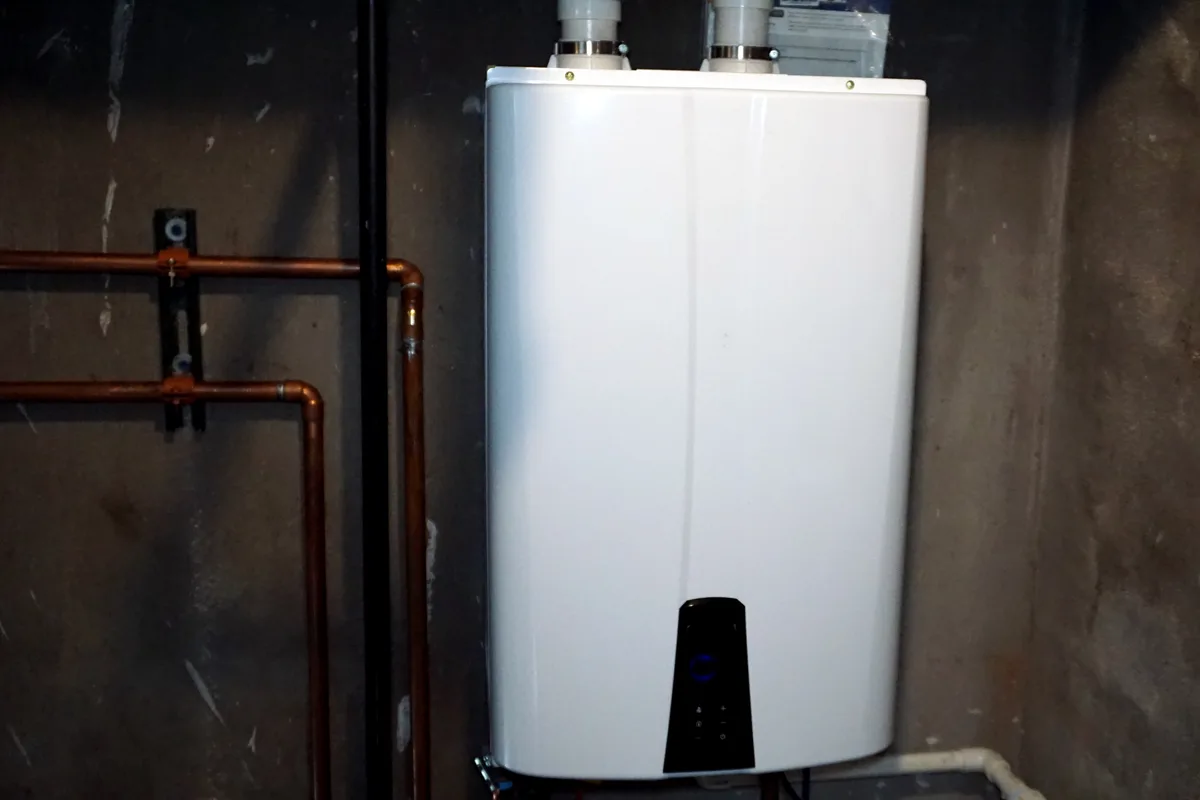
Quick answer
A tankless water heater needs descaling when the hot water temperature swings during a steady draw, hot flow has dropped while cold is normal, the unit rumbles or crackles as it fires, or it shows a scale or overheat code such as Rinnai LC or Navien E016. Flush it once a year, and every six months on hard well water without a softener.
You know your tankless water heater needs descaling when it starts behaving as if it were a size too small: the same shower, the same setting, and less comfort than a year ago. Scale is calcium and magnesium baked onto the inside of the heat exchanger tubing. It insulates the water from the flame and narrows the passage, so the unit runs hotter to deliver less. Left alone, the exchanger overheats, and that is the most expensive part in the cabinet.
Four symptoms of a scaled tankless heat exchanger
- Temperature that fluctuates during a steady draw. Scale makes sections of the exchanger overshoot, the outlet sensor sees a spike, and the burner throttles back, over and over. If the swings only happen at a trickle or when a second tap opens, that is a flow problem, not scale.
- Reduced flow on the hot side only. Compare the kitchen tap on full cold and full hot. A weaker hot stream at every fixture points to a narrowed exchanger or a plugged inlet filter.
- A kettling noise: rumbling, crackling or a sound like gravel while the burner is on. Water trapped under scale flashes into steam bubbles that collapse against the tube wall.
- A scale or overheat code. Rinnai units flash LC, the unit's own scale-detection warning, and keep running. Navien units lock out on E016, which means the heat exchanger overheated. Codes vary by model, and the chart inside the front cover wins.
One symptom alone can have another cause. Two together, on a unit that has gone more than a year without a flush, is scale until proven otherwise.
How hard is the water in Burlington, Oakville, Hamilton and Milton?
Lake Ontario water is moderately hard, around 7 grains per gallon, and that is what comes out of the tap in Burlington, Oakville and Hamilton. It is enough to scale a tankless that is never flushed, but slow enough that a yearly service keeps up with it.
Groundwater is the harder case. The parts of Milton, Georgetown and Caledon supplied from municipal wells, and any property on its own well, can see hardness at roughly double the lake figure or more. Scale builds faster than the calendar suggests there, and a unit can throw its first code well inside a year. The hard water and tankless guide for Hamilton and Halton goes through softeners and scale filters for those homes.
What a descaling flush involves
A descale circulates a mild acid through the heat exchanger for 45 to 60 minutes using the two isolation valves under the unit. Food-grade citric acid or plain white vinegar both dissolve calcium scale without harming the copper or stainless steel. The steps a technician follows:
- Power and gas off, and both main isolation valves closed so the heater is cut off from the house piping.
- Hoses on the two service ports, running to a small pump sitting in a bucket of solution.
- Solution pumped in through the cold port and back out the hot port in a loop for 45 to 60 minutes. Cloudy, gritty return water is the scale leaving.
- A fresh-water rinse for several minutes until the outlet runs clear.
- The cold-inlet filter screen pulled, rinsed and refitted, then the unit restarted and the outlet temperature checked against the setpoint.
A handy homeowner with the valves already in place can do this with a flush kit. If the unit was installed without isolation valves, they have to be added first, and anything involving the gas connection or the combustion side belongs to a TSSA-licensed gas technician.
How often to descale a tankless, and what it costs
- Lake-supplied water with no softener: once a year.
- Well or groundwater supply with no softener: every six months, or whenever a symptom appears.
- Softened water: a yearly check, with the flush interval stretched if the exchanger comes back clean.
- Annual descale flush: $150–$300.
- Diagnostic visit for a unit already showing a code: $90–$150, folded into the repair if you proceed.
The flush does not reverse damage. An exchanger that has been overheating for a season may have a failed sensor or a leak waiting, which moves the job into the $150–$800 repair band or to a written quote for the exchanger itself.
Call for service instead of flushing if
- The overheat code returns straight after a flush.
- Water is dripping from inside the cabinet.
- The unit shuts down mid-shower and will not relight.
- You smell gas or see scorching around the vent connection.
ZK Mechanical descales and repairs Navien, Rinnai and Bosch units in Burlington, Oakville, Milton, Georgetown and the rest of our service area, and a flush is part of the tankless maintenance service. If the unit is already locking out, start with tankless water heater repair, or call (647) 801-1252 or request a visit and tell us the code on the display.