
The problem
A furnace past 15 years that needs a heat exchanger, an inducer motor or a control board is a replacement decision, not a repair. The usual tell is a run of small failures across consecutive winters — a flame sensor one year, a pressure switch the next — rather than one dramatic breakdown. By that age the unit was almost always sized by rule of thumb, so it is oversized for the house, short-cycles on its high limit and never reaches its rated efficiency. Against a modern condensing furnace at the 95% AFUE federal minimum or better, that gap shows up on every gas bill.
What we did
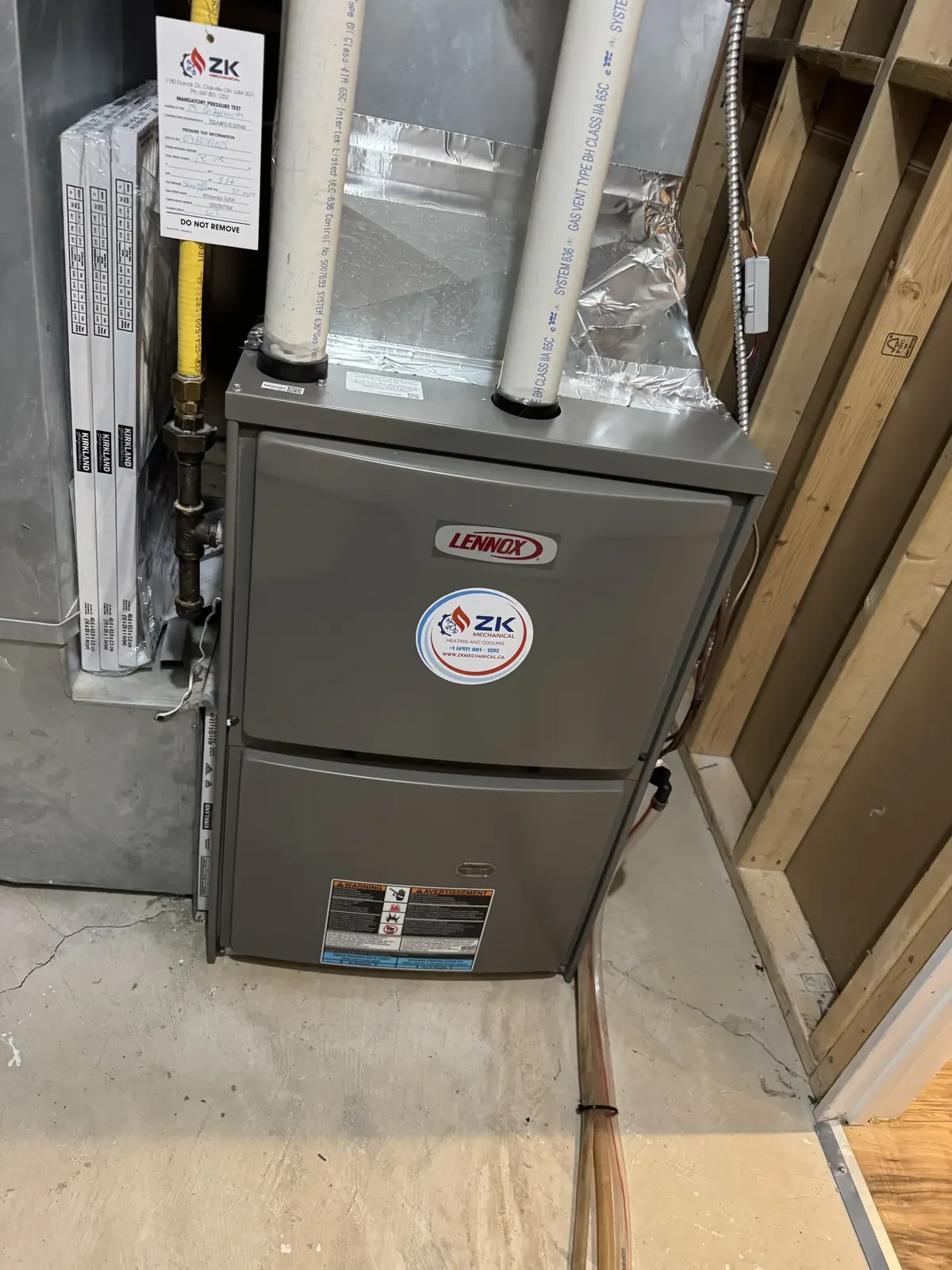
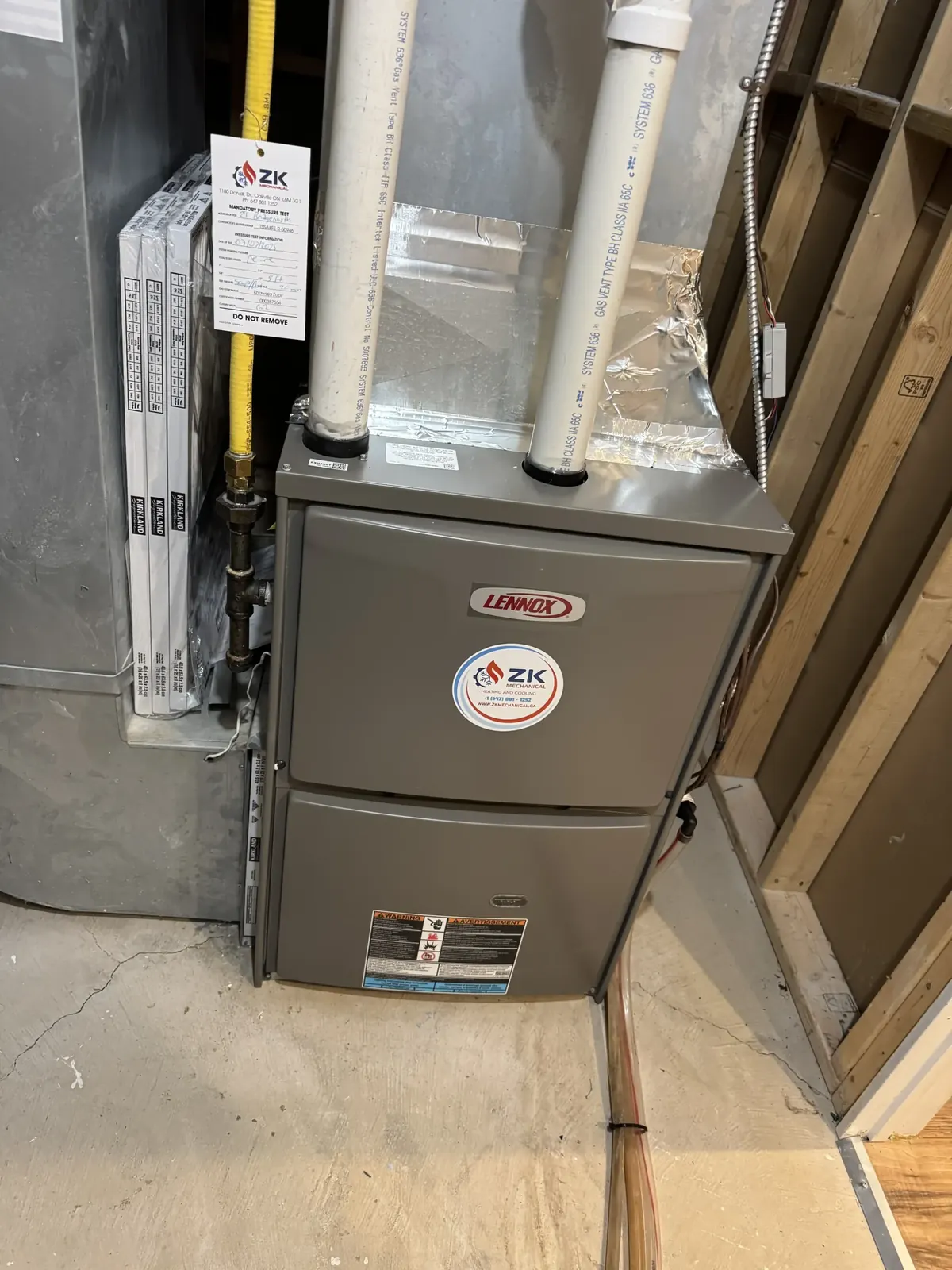
The replacement is a Lennox condensing furnace sized from a CSA F280 heat-loss calculation rather than matched to the old rating plate, which on most houses means a smaller input than what came out. A condensing unit vents in plastic pipe through the sidewall instead of up the chimney, so the intake and exhaust shown are new ULC S636 venting run to the manufacturer's slope and termination clearances. The gas line is reconnected and leak-tested to CSA B149.1 by a TSSA-licensed technician, and a trapped condensate drain is added because a 96% furnace produces acidic condensate as a normal by-product. The photographs show the finished cabinet with the venting and gas connections made up.
- Lennox high-efficiency condensing furnace
- PVC intake and exhaust venting
- New gas line connection
- Condensate drain and trap
The result
A furnace sized to the actual heat loss of the house, running longer and quieter cycles instead of blasting and shutting off, with a fresh manufacturer warranty registered in the homeowner's name. Where the job qualifies under a current Ontario program, the rebate paperwork is filed as part of the work rather than left with the homeowner.
Is this your situation?
This kind of work is worth a conversation if any of these sound familiar:
- Your furnace is past fifteen years and has needed a repair in each of the last two winters.
- A technician has quoted a heat exchanger, an inducer motor or a control board on an older unit.
- Gas use has crept up year over year with no change in how you heat the house.
- You want the work done while a rebate program is open rather than after a mid-winter failure.
Questions about this kind of job
Why does a 96% furnace need a condensate drain when the old one didn't?
A condensing furnace pulls extra heat out of the flue gas until water vapour condenses inside the secondary heat exchanger. That water is mildly acidic, so it drains through a trap into a floor drain, a laundry standpipe or a condensate pump, and a neutralizer cartridge is added where the drain is cast iron or runs to a septic system. The trap also stops flue gas escaping through the drain line.
Can the new furnace use the existing chimney?
No. A condensing furnace exhausts at a low temperature that would rot a masonry chimney, so it vents horizontally in ULC S636 plastic pipe through the sidewall. If a natural-draft water heater shared that chimney, it is now the only appliance on an oversized flue and usually needs a properly sized liner so its exhaust keeps drafting and does not condense inside the masonry.
How is the new furnace sized if not by matching the old one?
By a room-by-room heat-loss calculation to CSA F280, which accounts for insulation, window area, air leakage and the design temperature for the area. Furnaces installed in the 1990s and 2000s were routinely oversized by a third or more, so the replacement often has a lower input rating, runs longer cycles and holds a steadier temperature than the unit it replaces.
Does replacing a furnace need a permit or an inspection?
Gas work must be done by a TSSA-licensed technician and the connection leak-tested to CSA B149.1. Whether a building permit is required for a like-for-like furnace replacement varies by municipality, so check with the local building department before the work starts. Ontario's Hawkins-Gignac Act also requires a working carbon monoxide alarm near sleeping areas in any home with a fuel-burning appliance.