
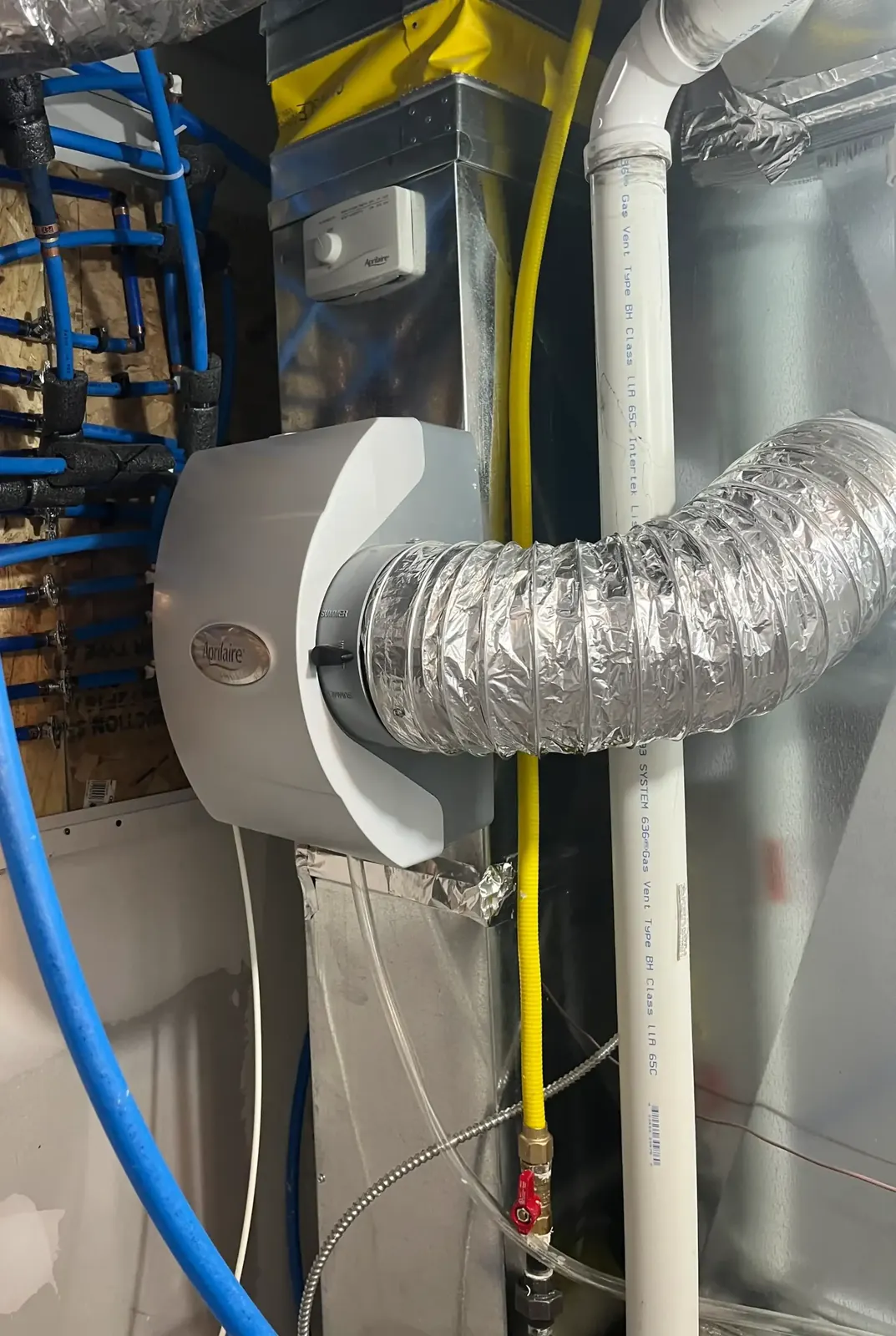
The problem
Two identical furnaces behave completely differently depending on the sheet metal around them and whether anyone measured anything after start-up. A cabinet forced onto plenums built for a different footprint leaks at the transitions and chokes airflow, so the furnace runs hot, trips its high limit and never delivers the capacity on its rating plate. Venting that is unsupported or sloped the wrong way collects condensate at the low point, which is a pressure-switch lockout waiting for the first cold night. None of that is visible in a brochure or on a quote.
What we did
The work shown is the sheet metal and the commissioning as much as the appliance. Supply and return transitions are fabricated to the new cabinet and sealed, the vent is supported at the intervals the manufacturer specifies and sloped back toward the furnace so condensate drains to the trap, and the thermostat and controls are wired and labelled. Once it fires, manifold gas pressure is set against the rating plate, temperature rise across the heat exchanger is measured against the printed range, and total external static pressure is read so the blower is not working against ductwork it cannot move air through.
- High-efficiency gas furnace
- Sheet-metal plenum transitions
- Vent piping
- Thermostat wiring and commissioning
The result
A furnace commissioned to its published specification with the numbers written down — gas pressure, temperature rise and static pressure — instead of assumed. That record is the difference between equipment that reaches its rated efficiency and equipment that quietly underperforms for a decade while nobody knows why, and it is the baseline every future service visit is measured against.
Is this your situation?
This kind of work is worth a conversation if any of these sound familiar:
- You are replacing a furnace and want the commissioning numbers recorded, not assumed.
- The current unit runs hot, loud, or never seems to deliver the capacity on its plate.
- A previous installation was dropped into the old opening without new transitions.
- You are comparing quotes and want to know what separates them beyond the equipment brand.
Questions about this kind of job
What does commissioning a furnace actually involve?
Setting manifold gas pressure to the rating plate, typically 3.5 inches of water column for natural gas, then measuring temperature rise across the heat exchanger and confirming it sits inside the printed range. Total external static pressure is read across the blower, the flame signal is checked in microamps, and the vent is inspected for slope and support. The readings are recorded so the next technician has a baseline.
Why does the exhaust vent have to slope back toward the furnace?
A high-efficiency furnace condenses water inside the exhaust pipe as the flue gas cools. If the pipe slopes away from the unit or sags between supports, that water pools at the low point, restricts the flue and trips the pressure switch, usually on a cold night under a long run. Sloping the pipe back to the furnace lets condensate run to the trap and drain.
Why can't the old plenums just be reused?
They can be reused when the new cabinet matches the old footprint, but most replacements change width, depth or coil position. A transition that is bent to fit rather than fabricated leaks return air from the basement, pulls in dust and combustion by-products, and restricts supply airflow, which pushes temperature rise past its limit. New transitions cost a little sheet-metal time and remove all of that.
How does temperature rise tell you the airflow is right?
Temperature rise is the supply air temperature minus the return air temperature while the furnace runs at full fire. Every furnace prints an acceptable range on its rating plate. A rise above the range means too little air is moving across the heat exchanger, which shortens its life; a rise below the range means the blower is oversped and the furnace runs cool and inefficient.