
The problem
Industrial and multi-tenant buildings rarely have one cooling load. Offices want 22 °C from eight to five, a shop floor wants heat and process fumes moved out on a different schedule, and a server or equipment room needs cooling at three in the morning in February. Serving all of that from one system means somebody is always uncomfortable, and when that system fails the whole building goes down together.
What we did
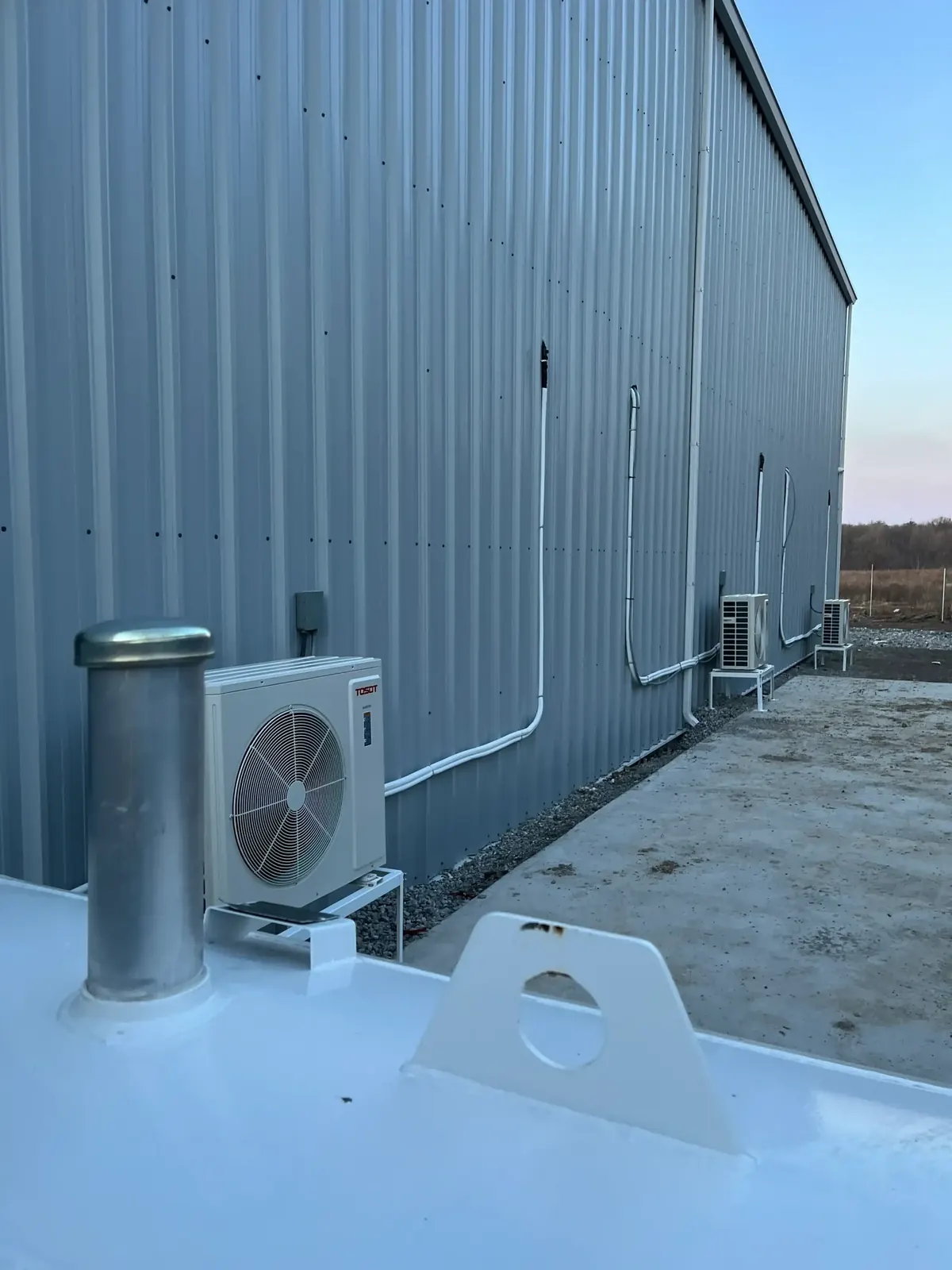
Separate condensing units along the exterior wall give each zone its own refrigerant circuit, its own disconnect and its own line set. The units in the photo are mounted on wall brackets rated for their weight with vibration isolators, spaced for service access, and each line set is kept within the manufacturer's length and rise limits so oil returns to the compressor. It costs more in equipment than one large system and it is worth it: a fault takes out one area, maintenance is staged one unit at a time, and each zone runs to what that space needs.
- Commercial condensing units
- Individual disconnects per unit
- Refrigerant line sets to each zone
- Wall mounting and supports
The result
Zone-by-zone cooling that can be serviced one unit at a time, with the offices unaffected when the shop-floor unit needs attention. For an operating business, being able to keep working during a repair is usually worth more than the difference in equipment cost.
Is this your situation?
This kind of work is worth a conversation if any of these sound familiar:
- The building has offices, a shop floor and equipment rooms with different needs.
- One system currently serves zones that run on different schedules.
- A fault takes out the entire building rather than one area.
- You need maintenance staged around production instead of a full shutdown.
Questions about this kind of job
Why mount condensers on the wall instead of the ground or the roof?
Wall mounting keeps the units above snow, forklift traffic and yard debris, needs no crane, and keeps the line sets short because the indoor units are usually just inside that wall. The brackets have to be rated for the unit's weight, fastened into the structure rather than the cladding, and fitted with rubber isolators so compressor vibration does not carry into the offices.
How long can a refrigerant line set be on a commercial split system?
Every manufacturer publishes a maximum total length and a maximum vertical rise for each model, and beyond those the compressor loses oil and capacity drops. Long runs may need additional refrigerant charge, larger pipe sizes or oil traps on vertical risers. Keeping each condenser close to the zone it serves is how the units in this layout stay inside those limits.
Can a server room be cooled by the same system as the offices?
It can, but it should not be. An equipment room needs cooling year-round and often at night, while the office system shuts down or runs a setback. A dedicated unit for the equipment room runs its own schedule, can be sized for a steady heat load, and keeps a failure in the office system from shutting down the servers. It also allows a low-ambient kit for winter operation.
Does splitting the building into zones cost more to run?
Usually less. Each unit only runs when its zone calls, so the shop floor is not being cooled to office temperature on a Sunday and the offices are not being conditioned because the server room needs it. Equipment cost is higher up front, and there are more units to maintain, but the running cost and the downtime exposure both come down.