
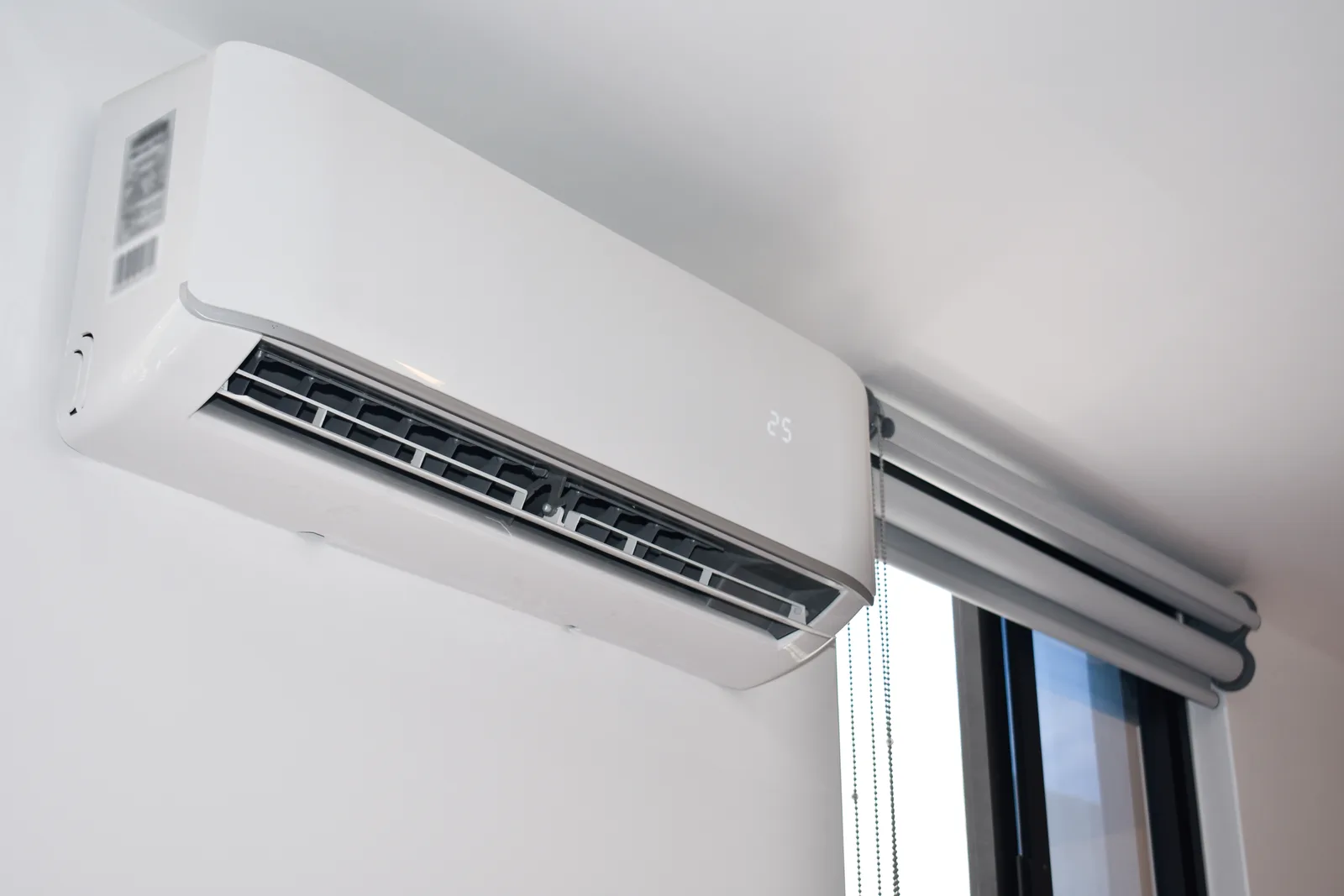
Backyard office heating and cooling in Ontario is a one-machine job: a cold-climate single-zone ductless heat pump of 6,000 to 9,000 BTU carries a small insulated studio through January and July. Bigger is worse, because an oversized unit short-cycles and leaves the room clammy in summer. The parts that need planning are the power, which is a dedicated circuit trenched from the house under an ESA permit, and the condensate drain, since the building has no plumbing.
What Size Heat Pump Does a Backyard Office Need?
Most backyard offices need the smallest unit a manufacturer makes. A detached studio of roughly 100 to 200 square feet, insulated in the walls, floor and roof, has a heating load well under what a 9,000 BTU cold-climate unit delivers, and most product lines bottom out at 6,000 or 9,000 BTU.
The minimum output matters as much as the nameplate. An inverter compressor slows down to match the load, and each model has a floor it cannot go below. In a tiny room on a mild day, a unit that cannot turn down far enough reaches setpoint in minutes, shuts off and starts again. That short cycling wears the compressor, swings the temperature and, in cooling, stops the coil from running long enough to pull moisture out of the air.
Ask for the minimum capacity on the specification sheet, not only the rated one. Our answer on what size mini-split you need explains the load calculation; for an office, add the heat from people, computers and any large south or west glass.
Heat Pump vs Baseboard Heater and a Window Air Conditioner
For an office used most weekdays all year, the heat pump wins. For a studio used a day or two a week, a baseboard heater is a defensible way to save on the purchase. The options compare like this:
- Electric baseboard or wall heater plus a window or portable AC: the lowest purchase price and the highest running cost, and the window unit blocks the one window you have.
- Cold-climate ductless heat pump: one quiet machine for both seasons that delivers more heat than the electricity it consumes. A single indoor head with its outdoor unit is $4,000–$7,000 installed, and choosing a cold-climate model adds roughly $500–$1,500. The trench and electrical feed are separate and quoted by the electrician.
- Portable propane or kerosene heaters: not for a closed, occupied room. They put combustion gases and moisture into the air you are breathing.
Standard and cold-climate models differ in how much heat they hold onto as the temperature falls, and that is the whole point in a building with no backup. Our comparison of cold-climate vs standard heat pumps shows where the gap opens.
Power: A Dedicated Circuit, a Trench and an ESA Permit
The heat pump needs its own circuit from the house panel, run underground to the office, and that electrical work needs an ESA permit no matter how small the building is. A licensed electrical contractor files the notification with the Electrical Safety Authority, buries the cable or conduit to the depth the Ontario Electrical Safety Code requires, and has it inspected.
Do not confuse this with the building permit question. The Ontario Building Code exempts a shed from a building permit when it is no more than 15 square metres, one storey, detached, without plumbing and used only for storage. An office you sit in all day is not storage, so ask your municipal building department, whether the City of Burlington, the Town of Oakville, the Town of Milton or the City of Hamilton, how it treats a small studio before you build. Whatever the answer, the shed exemption never covers the wiring.
In practice most offices get a small subpanel, not a single circuit, because the building also needs lights and receptacles. Tell the electrician the heat pump's voltage and breaker size before the trench is dug: small units come in 120-volt and 240-volt versions depending on the brand, and the outdoor unit needs a disconnect switch within sight of it. If the house panel is already full, our guide to an electrical panel upgrade for a heat pump explains the options.
Line-Set Routing and Where the Outdoor Unit Sits
Free quotes, written pricing.
The simplest install puts the outdoor unit directly behind the indoor head, with the refrigerant lines passing straight through the wall. Manufacturers set a minimum line-set length, so a back-to-back install often needs extra tubing coiled neatly behind the unit instead of a shorter cut. A line set shorter than that minimum can carry compressor noise and vibration into the indoor head.
Wall bracket or ground pad? On a shed-framed office we prefer a ground stand. A light stud wall with thin sheathing acts like a drum skin, and compressor vibration that would vanish into a brick wall becomes a hum inside a small, quiet room. Set the stand on a level pad or patio slabs, high enough to clear drifted snow, and out from under the roof edge so meltwater and icicles do not land on the unit.
In heating mode the outdoor unit defrosts itself through the day in cold, damp weather, and the meltwater drips from its base. Keep the unit away from the path between the house and the office door, or that water becomes a sheet of ice exactly where you walk.
Condensate Drainage in a Building With No Plumbing
In cooling mode the indoor head pulls water out of the air, and with no drain in the building that water has to leave by gravity. The drain hose exits through the same wall opening as the line set, slopes downward the whole way with no dips, and ends over a gravel bed or splash block that carries water away from the foundation or skids.
- Mount the indoor head high enough that the drain can fall all the way to its outlet.
- Keep the outlet clear of the ground so it cannot plug with soil.
- Do not end it over the doorstep or against a wood skid that will rot.
- Avoid a condensate pump unless there is no gravity route. A pump is one more part to fail and one more sound in a quiet room.
On a humid summer day near Lake Ontario a small head can produce a few litres of water, so a drain that dribbles down the cladding will stain it within a season.
Insulate First, and Leave It Running in Winter
The heat pump is sized for the building as insulated, so insulate before you buy. Walls, floor and roof all count in a small detached building, and the floor matters most when the office sits on skids or piers with air moving underneath. A bare shed needs several times the heat of an insulated one, and no small heat pump keeps up with a room that leaks at every joint.
In winter, leave the unit on at a low setpoint overnight and on weekends instead of switching it off. A cold-soaked room with a cold floor and cold furniture takes hours to feel warm again, and holding 12–15°C costs little in a small insulated space. It also spares monitors, printers and paper from repeated freezing and condensation.
Verdict: The Setup We Recommend
- Equipment: a 6,000–9,000 BTU cold-climate single-zone ductless heat pump, chosen for its low minimum output.
- Mounting: the indoor head high on the wall opposite the desk so air does not blow on you; the outdoor unit on a ground stand, clear of snow and the roof edge.
- Power: a subpanel fed by a trenched circuit, installed by a licensed electrical contractor under an ESA permit.
- Drain: gravity to a gravel bed, no pump.
- Baseboard heat instead: only if the office is occasional-use and you can live without cooling.
We handle the heat pump: sizing, mounting, line set, evacuation, commissioning and the condensate drain. Your electrician handles the trench and the feed, and we agree the breaker size and disconnect location with them before either trade starts. If the building will have a bathroom, a kitchen or a bed, it is a dwelling, and the guide to garden suite and laneway house HVAC applies instead. See our ductless mini-split service or request a written quote.
Frequently asked questions
Can I install a DIY mini-split kit in my backyard office?
You can buy one, but two parts of the job are not homeowner work in Ontario. Handling refrigerant requires a technician with an ODP card, and the electrical feed needs an ESA permit and inspection. Manufacturer warranties also commonly depend on installation by a licensed contractor. A kit installed without a proper vacuum and leak test tends to lose its charge within a few seasons.
Do I need a building permit for a backyard office in Ontario?
Possibly. The Building Code's shed exemption covers detached, single-storey sheds of 15 square metres or less with no plumbing that are used only for storage, and an office is not storage. Municipal zoning rules on setbacks, height and lot coverage apply regardless of size. Call your municipal building department before you order the building.
Will a heat pump heat an uninsulated shed?
Not well, and not economically. An uninsulated shed with air leaking at every joint can lose heat faster than a small heat pump supplies it on a cold, windy day, and the unit will run flat out without reaching setpoint. Insulate the walls, floor and roof and seal the gaps first; then the smallest cold-climate unit is enough.
Can the office heat pump run from an extension cord or an outdoor receptacle?
No. A heat pump needs a dedicated, permanently wired circuit sized to the manufacturer's breaker and wire specification, with a disconnect at the outdoor unit. An extension cord run across a yard overheats under continuous load, is exposed to water and damage, and would not pass an Electrical Safety Authority inspection.