
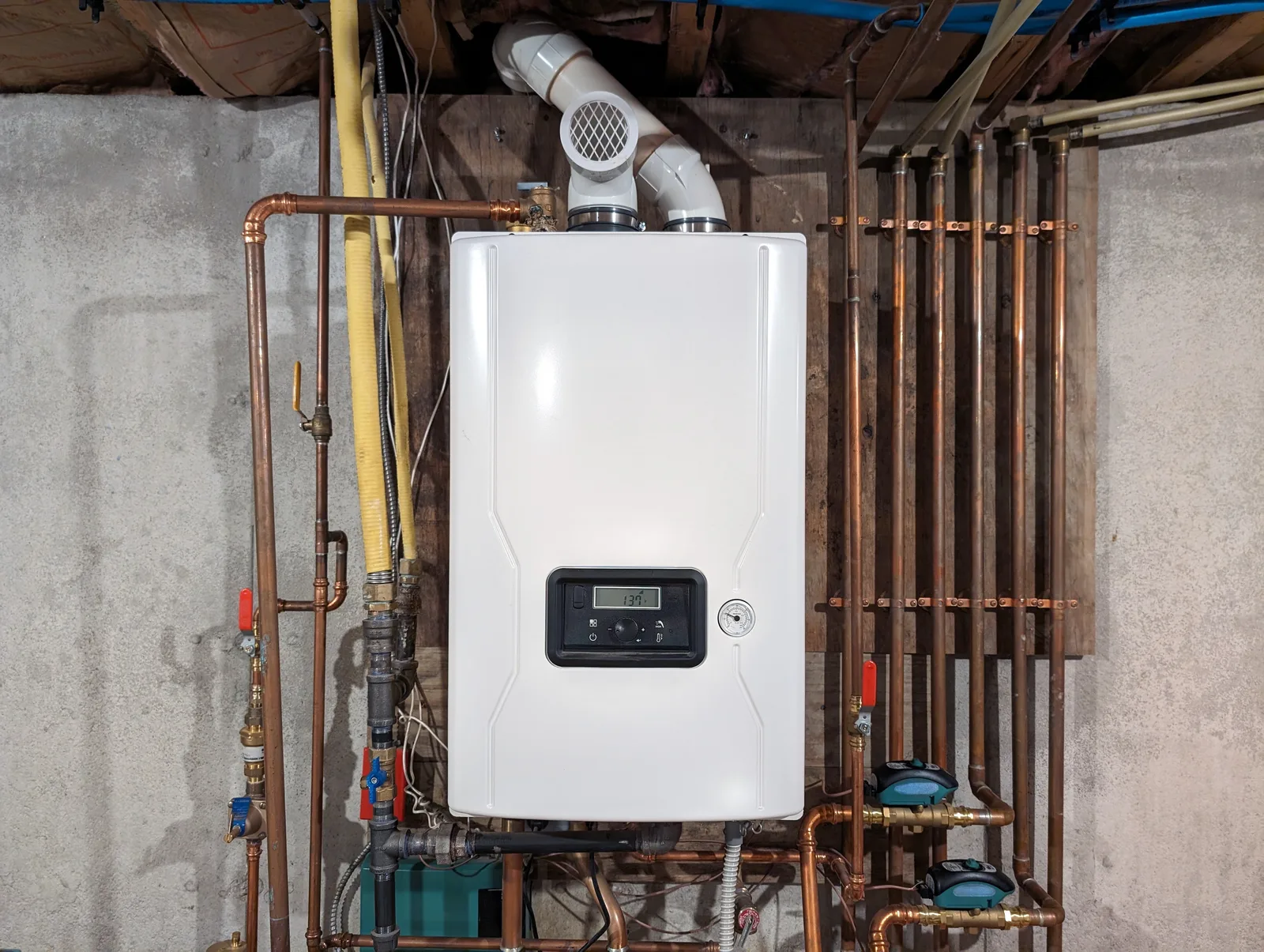
Quick answer
A tankless water heater that is not igniting is missing gas, spark or air. The display shows an ignition-failure code: E003 on Navien, 11 on Rinnai and Noritz. Check that the gas valve is open and the vent termination outside is clear of snow, ice or nests, then power-cycle once. If the code returns, the igniter, flame rod, gas pressure or condensate trap needs a licensed technician.
Your tankless water heater is not igniting because the burner tried to light, the control saw no flame within a few seconds, and it gave up after its allowed attempts. You hear the fan start, sometimes a rapid ticking from the igniter, then nothing, and a code appears. The causes fall into three groups: fuel, ignition parts, and air or drainage.
The ignition-failure codes: Navien E003, Rinnai 11, Noritz 11
Each brand has its own number for the same event: the gas valve opened, the igniter fired and the flame rod never reported flame.
- Navien E003: ignition failure.
- Rinnai 11: no ignition.
- Noritz 11: ignition failure.
The code confirms the symptom, not the cause. Numbering changes between model generations, so go by the table in your own manual if it disagrees with any list online. An ignition code is not dangerous in itself, since the control closes the gas valve when it sees no flame, but it will not clear up without the cause being fixed.
Check these before you call
- The gas valve under the unit: handle in line with the pipe is open.
- Other gas appliances: if the furnace and range are out too, the problem is the supply or the meter, and that is an Enbridge Gas call.
- The vent termination outside: clear snow drifts, ice, leaves or nesting material from both intake and exhaust by hand.
- The condensate line on a condensing unit: look for a kinked, frozen or overflowing drain tube. A frozen unit is its own problem, covered in what to do if a tankless water heater is frozen.
- One power cycle: unplug for 30 seconds, plug back in and open a hot tap fully.
- After recent gas work or a new install: air in the line can take several tries to purge, and if the installer has just left, call them back.
Do not open the sealed combustion chamber, and do not keep resetting. Each failed attempt releases a small amount of unburnt gas into the chamber before the valve closes.
Dirty igniter or flame rod, failed ignition transformer, blocked vent or backed-up condensate trap
Inside the burner, two electrodes make the spark and a flame rod detects the result. Combustion leaves a white or grey oxide on all three. A coated igniter throws a weak spark that will not light the mixture; a coated flame rod cannot see a flame that is there, so the control shuts the gas and reports a failed ignition anyway. Cleaning and re-gapping them is routine service, and when there is no spark and no ticking at all, the ignition transformer that feeds the electrodes has usually failed.
A tankless burner is fan-fed and sealed, so it is sensitive to anything that changes airflow. Wind-packed snow against a low sidewall termination, ice built up from the unit's own exhaust moisture, and spring nests in the intake are the usual finds. Condensing models add one more: acidic condensate from the heat exchanger drains through a trap, and when that trap or its line plugs or freezes, water backs up into the burner area and wets the igniter. The cure is clearing and flushing the trap, then correcting the slope or route of the drain so it cannot hold water in an unheated space.
An undersized 1/2-inch gas line, and pressure that drops when the furnace fires
A tank water heater burns about 40,000 BTU an hour, and a whole-home tankless can burn 199,000. Hang one on the 1/2-inch branch that fed the old tank and it may light on a mild day and fail on a cold morning, when the furnace is also firing and the pressure at the tankless inlet sags below the minimum on its rating plate. The tell is ignition failure that comes and goes with other appliances.
This is measured, not guessed. A TSSA-licensed G2 technician puts a manometer on the inlet test port and reads the pressure with the unit off, then at full fire with the furnace running. Ontario homes are normally supplied at about 7 inches of water column, and the reading under load has to stay above the rating-plate minimum. The technician then sets up combustion with an analyzer against the manufacturer's figures.
If the line is the problem, the fix is a larger or dedicated run sized under the CSA B149.1 gas code. When that applies is explained in does a tankless water heater need a bigger gas line.
What it costs to fix a tankless that will not ignite
- Diagnostic call: $90–$150, counted toward the repair when you book it.
- Gas line upsizing: $400–$1,200.
- Descale flush, often done on the same visit on a unit that has never been serviced: $150–$300.
- Igniter, flame rod, transformer or condensate repairs: priced in writing before the work.
ZK Mechanical services Navien, Rinnai and Bosch tankless units, and its technicians hold TSSA gas licences. For tankless water heater repair in Burlington, Oakville, Milton, Hamilton or Mississauga, call (647) 801-1252 or send us the code and model number.