
Quick answer
Rinnai error code 11 means no ignition: the heater tried to light its burner, no flame was established, and it has locked out. Verify that every gas valve feeding the heater is open, then reset once. If code 11 returns, leave the heater off and call a TSSA-licensed gas technician. If you smell gas at any point, leave the house and call Enbridge Gas from outside.
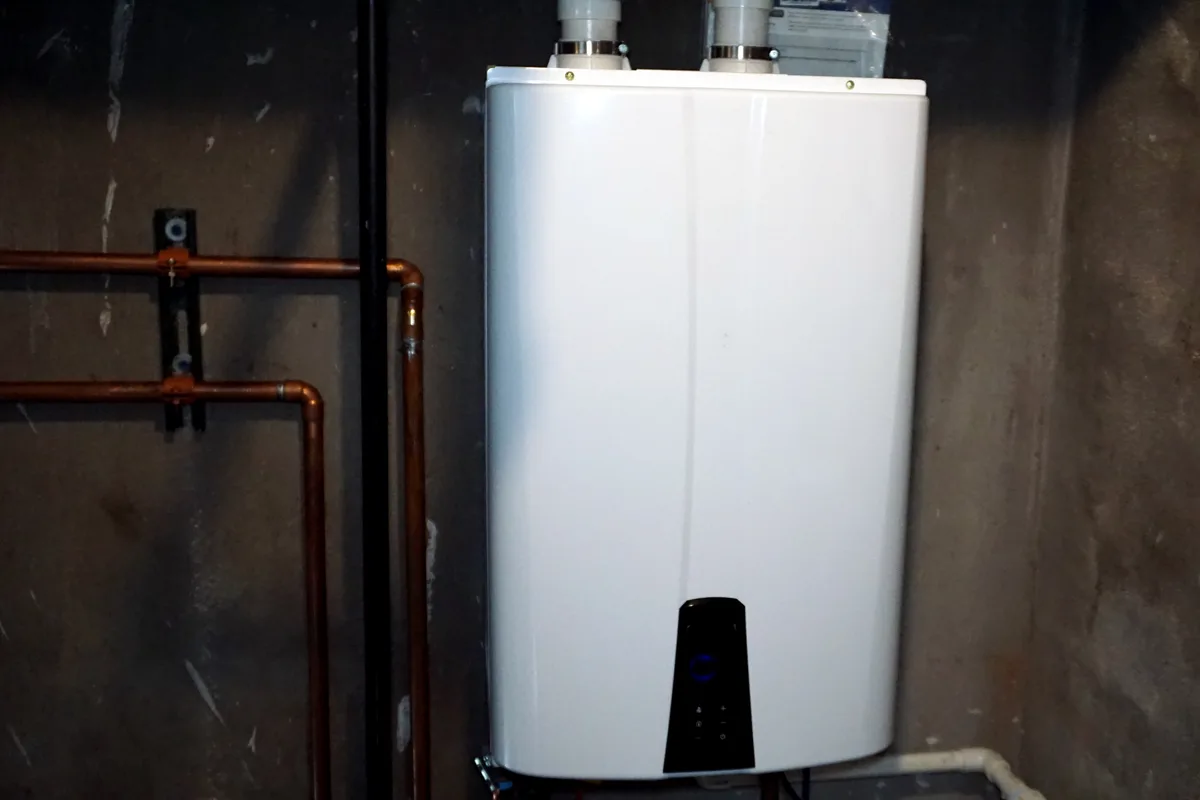
When a hot tap opens and the burner never lights, the display shows Rinnai error code 11, which the manufacturer's diagnostic guide defines in two words: no ignition. The heater has tried to fire, seen no flame, and locked out. Nothing is burning at that point, but the reasons behind the lockout sit on the gas side of the appliance. Check the label inside the panel for the wording on your model; where that data sheet differs from a web page, the sheet is right.
Can you reset a Rinnai code 11 and keep using it?
One reset is fine. Turn the heater off and on at the controller, open a hot tap, and watch whether it lights. A unit that fails to light a second time should be left off: every attempt opens the gas valve for a moment, and repeating that is not a repair.
If you smell gas near the heater, the meter or the propane tank, do not touch the controller. Leave the house and call Enbridge Gas or 911 from outside. What to do if you smell gas lists the steps in order.
The safe homeowner step: confirm every gas valve is open
Step 1 of Rinnai's own code 11 procedure is to verify that all gas valves on the system are open, and it is the only step in that procedure a homeowner should take.
- The appliance shut-off on the gas line just below the heater: open means the handle sits in line with the pipe, closed means it sits crossways.
- The main valve at the gas meter, if the utility or a contractor has been working at the house.
- On propane, the gauge and the valve at the tank. An empty or nearly empty tank gives the same code.
- The other gas appliances: if the furnace and range have no gas either, the problem is the supply, not the Rinnai.
Reset once after checking. Do not loosen a fitting, and do not take the front cover off to look at the burner.
Why a Rinnai fails to ignite, in order of likelihood
- A closed gas valve or an empty propane tank. Both turn up after a meter change, a renovation or a missed delivery.
- Air left in the gas line. A new installation, or a line opened for other work, has to be purged before the burner will light.
- Inlet gas pressure below the rating-plate minimum at high fire. Rinnai requires the minimum inlet pressure to be held with every gas appliance at the location firing on high; a line sized for an old tank often cannot do it.
- The wrong gas-type setting. A heater set for propane on a natural gas supply, or the reverse, will not light reliably; on SENSEI models the setting is Parameter 10, on older models a DIP switch on the board.
- An igniter or electrode fault: a ceramic electrode loose in its bracket, the wrong spark gap, carbon or a white deposit on the flame rod, or a damaged igniter wire.
- Blocked or badly assembled venting, which lets combustion gases recirculate into the air the burner is trying to light with.
What the technician tests on a code 11 call
The first instrument out of the bag is a manometer. Inlet pressure is measured at the test port on the bottom of the heater with the Rinnai, the furnace and every other gas appliance firing at once, then compared with the rating plate on the side of the cabinet. If the pressure sags under load, the fault is in the piping, the regulator or the supply, and no part inside the heater will fix it.
If pressure holds, the technician checks for spark, confirms the electrode gap (Rinnai specifies 3.5 mm), makes sure the electrode and flame rod are tight in their bracket, and cleans or replaces them with a new gasket. Gas type and venting are confirmed last. Inlet-pressure testing under load and igniter work need a manometer and a TSSA G2 licence; you can verify a TSSA licence before anyone opens the cabinet.
What fixing code 11 costs
- Service call and diagnosis: $90–$150, credited toward the repair when you proceed.
- Igniter, electrode and flame rod work, along with most other tankless repairs: $150–$800.
- Upsizing an undersized gas line to the heater: adds $400–$1,200, depending on the length of the run.
Rural lots in Lowville, Kilbride, Campbellville, Carlisle and rural Caledon sit beyond the natural gas mains and many heat water with propane, so a code 11 there starts at the tank gauge. In town, on Enbridge gas, it starts with the valves and the size of the line. ZK Mechanical's tankless water heater repair service covers Rinnai in both settings: call (647) 801-1252 or request a visit. The sister fault is code 12, flame failure, and every other code is in the Rinnai error code list.