
Quick answer
A mini-split remote stops working for four reasons: weak batteries, a child lock, a blocked or failed infrared receiver on the head, or a dead remote. Fit two fresh alkaline batteries, press the reset pinhole, and point the remote at a phone camera: a flashing light on screen means the remote transmits. Meanwhile, the manual button under the front panel runs the unit.
A mini-split remote not working is a batteries-and-settings problem before it is a broken unit, and you can prove which in about five minutes. The remote talks to the head with infrared light, the same as a TV remote. So there are only three places to look: the remote, the path between, and the receiver behind the head's display.
Check this yourself first
- Batteries: replace both with new alkaline cells, matching the + and − marks. A dim or blank display means batteries, even if the remote worked last week. Wipe any white corrosion off the contacts.
- Reset: many remotes have a recessed reset button beside the batteries or on the face. Press it with a paper clip after changing batteries, then set the clock again if the remote has one.
- Child lock: a padlock symbol on the display means the buttons are locked. The release is a button combination held for a few seconds, and it differs by brand, so check the manual for your model.
- Mode and timer: confirm the remote shows the mode you want and that no off-timer is set. On a multi-zone system a head refuses a mode that conflicts with the other heads; see one mini-split head not working.
- Line of sight: stand a few metres away, directly in front, and aim at the display side of the head. Remove anything hanging in front of it.
Test the remote's infrared LED with a phone camera
Open the camera on your phone, point the front of the remote at the lens and press any button. A working remote shows a flashing white or violet dot on the screen that your eye cannot see directly. Some rear cameras filter infrared, so try the front-facing camera if you see nothing.
The result splits the problem in two. A flash on screen and no beep from the head: the remote is fine, and the fault is the receiver, the head's power, or interference. No flash with fresh batteries: the remote is dead and needs replacing.
Receivers get blinded as well as broken. Direct sunlight on the head, and some fluorescent or LED fixtures close to it, can swamp the signal, a point several manufacturers make in their manuals. If the remote works at night or with the lights off, that is your answer. A receiver that has failed is a small board behind the display, replaced as a part.
Run the unit from the manual button in the meantime
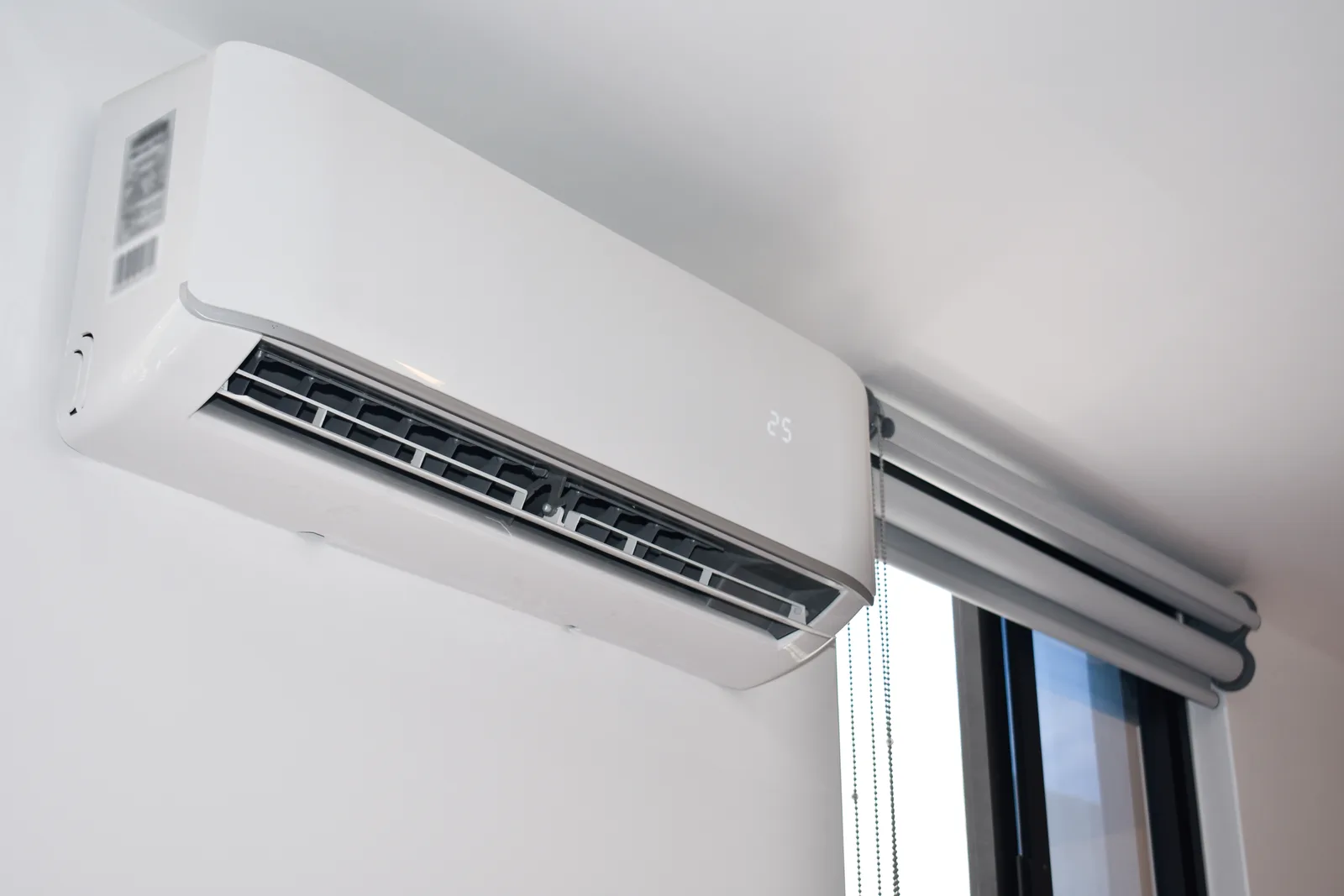
Wall-mounted heads have a button for running without a remote. Lift the front panel, the one you open to reach the filters, and look along the edge of the chassis for a small button marked ON/OFF, AUTO or Emergency Operation. One press starts the unit in an automatic mode at a factory-set temperature; another press stops it.
You cannot change the setpoint or fan speed this way, so it is a stopgap. It also doubles as a test: if the head runs from the button, its power and main board are sound, and the problem is confined to the remote or the receiver. If it does not respond at all, read why a mini-split won't turn on.
OEM or universal: choosing a replacement remote
Buy the manufacturer's remote for your model when you can. The model number is on the nameplate, on the underside or side of the head or under the front panel, and the original remote keeps every function: vane positions, quiet and powerful modes, timers, and heat mode on a heat pump.
- OEM remote: matched to the model number, works out of the box, full functions.
- Universal remote: needs a brand code entered, and usually gives power, mode, temperature and fan speed only. Some drop swing or special modes, and a cooling-only code set leaves you without heat.
- Phone app through a smart infrared controller: handy, but it still sends infrared, so it cannot get past a failed receiver.
Adding a Wi-Fi adapter or a wired wall controller
If remotes keep going missing, or the head sits where infrared cannot reach it, a permanent control is the better fix. Most manufacturers sell a Wi-Fi adapter that plugs into a port on the indoor board and puts the unit on their phone app. A wired wall controller connects to the same board by cable and gives you a thermostat-style panel on the wall, and on many models it can sense room temperature at the panel instead of up at the head.
Both need a compatible indoor model and a technician to open the head and connect to the board with the power off. We price the part and the installation in writing, since neither has a single published figure. If a technician has to come out to diagnose a dead receiver, the visit is $90–$150 and is credited to the repair.
For a head that ignores a working remote, or to add a wall controller on a Mitsubishi, Fujitsu or Daikin system, see our ductless mini-split service and mini-split repair pages. Have the model number from the nameplate ready and message ZK Mechanical, or call (647) 801-1252 during shop hours: Monday to Friday 7 AM to 9 PM, Saturday 8 AM to 6 PM. Other ductless questions are collected under heat pump answers.