
If your house already has ductwork in decent condition, central air is the cheaper way to cool the whole place — $3,500–$7,500 installed against $4,000–$7,000 for a single ductless zone that cools one room. If there are no ducts, or one stubborn room the ducts never reached, ductless wins and it is not close. The decision is mostly made by what is already inside your walls.
What each system actually is
Central air pairs an outdoor condenser with an indoor coil sitting on top of your furnace. The furnace blower pushes air across that coil and out through the ducts you already use for heat, so one thermostat controls the whole house and there is nothing visible in any room beyond the registers.
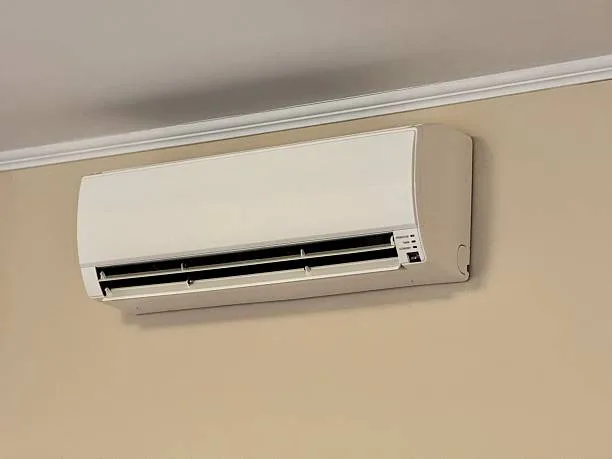
A ductless mini-split pairs an outdoor unit with one or more indoor heads mounted on a wall, in a ceiling cassette, or in a slim ducted casing above a closet. Each head has its own fan, its own coil and its own remote, so each one is a separate zone. Nothing runs through the house except a bundle of refrigerant lines, a condensate drain and a control cable.
Installed cost compared
- Central air with existing ducts in good condition: $3,500–$7,500 installed, whole home
- Single-zone ductless, one indoor head: $4,000–$7,000 installed
- Dual-zone ductless: $7,500–$11,000 installed
- Three to four zones: $10,000–$16,000+ installed
- Cold-climate models that heat as well as cool: add roughly $500–$1,500 per zone
- Central air where ducts must be added: the duct work becomes the largest line on the quote, and in a finished house it usually costs more than the cooling equipment
The pattern is straightforward. Central air is cheap per room and expensive to start when ducts do not exist. Ductless is expensive per room and cheap to start. Somewhere around three or four zones the ductless quote passes what a full central system costs — see our GTA AC installation cost guide for the full central breakdown.
Where ductless is the right answer
- Houses with hot-water radiators or electric baseboards and no ducts at all — the whole reason mini-splits exist in older Ontario neighbourhoods
- A bonus room over a garage, a finished attic, or a third-floor bedroom that the trunk line never properly reached
- A basement apartment or in-law suite that needs its own control and its own bill
- An addition or a sunroom, where extending the existing duct system would unbalance the whole house
- A home office you want cool at 2 p.m. without cooling four empty bedrooms to get there
- Any of the above where you also want heat — a cold-climate head warms the same room in January, which is what makes the price defensible
That last point is the one people underrate. If a room is the coldest in the house in winter and the hottest in summer, one ductless head fixes both problems with one machine — often the cheaper answer than rebuilding ducts, and the reasoning is set out in why one room is always colder than the rest.
Where central air is the right answer
If the ducts are there and sound, central air cools every room for one price, hides entirely, and uses the filter cabinet, humidifier and any air cleaner already on the furnace. That whole-home filtration is a genuine advantage for allergy households, because a mini-split head has a washable screen and nothing else.
Free quotes, written pricing.
It also keeps a single point of service. One coil, one condenser, one drain, one filter — against a house with four heads, four drains and four sets of filters to wash. And it stays invisible: no unit on the living-room wall, which matters to some households more than any efficiency number.
Side by side on the eight things people ask about
- Upfront cost, whole home — central $3,500–$7,500 with ducts; ductless climbs with each zone to $10,000–$16,000+ at three or four
- Zoning — central is one thermostat for the house; ductless gives every head its own setpoint
- Visibility — central shows only registers; ductless puts a unit on the wall of each room it serves
- Heating — central AC cools only; a cold-climate ductless head heats through an Ontario winter as well
- Filtration and humidity — central uses the furnace filter, humidifier and air cleaner; ductless heads have washable screens and no humidification
- Duct losses — central loses some capacity through leaky or uninsulated runs; ductless has no ducts to leak
- Installation disruption — central is a one-day changeover where ducts exist; ductless needs a core drilled through an exterior wall for each head
- Service — central is one system to maintain; ductless is one outdoor unit plus a coil, a drain and a filter per head
The practical constraints on a ductless install
Each indoor head needs a hole through the exterior wall for the refrigerant lines, the control wire and the condensate drain, and that drain runs by gravity. A head on an interior wall or below the outdoor unit needs a small condensate pump, which is an extra part and a small noise. Head placement is therefore a conversation about drainage as much as about where it looks best.
The outdoor unit needs a spot too — a pad, a wall bracket or a stand that keeps it above the snow line, with somewhere for defrost water to go that is not the walkway you use in January. On a narrow lot with a shared side yard, that spot is worth agreeing before anyone quotes.
The hybrid most GTA homes actually end up with
Plenty of houses do best with both: central air for the ducted main floors and one ductless head for the space the ducts never solved — the room over the garage, the finished basement, the attic bedroom. That way you pay the cheap per-room price where ducts exist and the ductless premium only where it earns its keep.
If you are also thinking about heating, price the ductless side as a cold-climate heat pump rather than a cooling-only unit. The premium is modest and it changes what the machine is for — the winter performance is covered in our cold-climate heat pump guide, and the room-by-room case in whether a ductless mini-split is worth it in Toronto.
How to decide in five questions
- Do you have ducts, and are they sound? If yes, central is the default and the burden of proof is on ductless.
- How many rooms genuinely need cooling? One or two favours ductless; the whole house favours central.
- Do you want heat from the same machine? That pushes toward a cold-climate ductless system.
- Does anyone in the house need whole-home filtration or humidification? That pushes toward central.
- Can you live with a unit visible on the wall? If not, the answer is central or a slim ducted head hidden above a closet.
ZK Mechanical installs both across the GTA and Hamilton and will quote them side by side for your house rather than steering you to one. Our cooling services page covers what each install involves, and you can book an assessment to have the duct system looked at before you decide which of these two conversations you are actually having.
Frequently asked questions
Is a ductless mini-split cheaper than central air?
Per room, no. A single-zone ductless system runs $4,000–$7,000 installed and cools one space, while central air runs $3,500–$7,500 and cools the whole house — provided ducts already exist. Ductless becomes the cheaper option only when the house has no ductwork, because adding ducts to a finished home usually costs more than the cooling equipment does.
Can a ductless mini-split cool a whole house?
It can, with enough heads, but the economics turn against it. Three or four zones run $10,000–$16,000 or more, and you still get no whole-home filtration or humidification and a unit visible in each room. Mini-splits are strongest where ducts do not exist or where you want independent control of a few specific spaces rather than the whole floor plan.
Do mini-splits work in Ontario winters?
Cold-climate models do, and they are a different product from the cooling-only units. They use variable-speed compressors and enhanced-vapour-injection compressors to keep producing usable heat well below freezing, and manufacturers publish rated capacity down to low outdoor temperatures. What matters is checking the rated output at the temperature you care about rather than the operating floor the brochure advertises.
How noisy is a ductless head?
Quieter than a furnace blower at full speed and quieter than a window unit by a wide margin. The indoor head is a small fan across a coil, and on low speed most people stop noticing it. The outdoor unit makes more noise than the head does, which matters on a narrow lot where it may sit close to a neighbour's bedroom window — worth siting deliberately rather than wherever the lines are shortest.