
Quick answer
Hot water pressure that is low while cold is fine means a restriction on the hot side only, between the heater's cold inlet and the taps. Check the shut-off valve above the water heater first; a partly closed or broken valve is the most common cause. Next come scale in the outlet nipple or heat-trap fittings, a clogged tankless inlet filter, a mixing valve, or old galvanized pipe.
If your hot water pressure is low but cold is fine, the house pressure itself is not the problem. Both sides are fed from the same main at the same pressure. What you are seeing is reduced flow: something is narrowing the path the hot water takes, and that path starts at the cold inlet of the water heater. Finding it is a matter of working out whether every hot tap is weak or just one.
One tap or every tap?
One weak hot tap points to that fixture: an aerator packed with grit, a clogged cartridge, a kinked supply hose or a partly closed stop valve under the sink. Unscrew the aerator and run the tap without it. If the flow comes back, rinse or replace the aerator; if not, the cartridge or supply line is next.
Every hot tap weak, with strong cold everywhere, puts the restriction at the water heater or in the main hot line leaving it. The sections below take that case one location at a time.
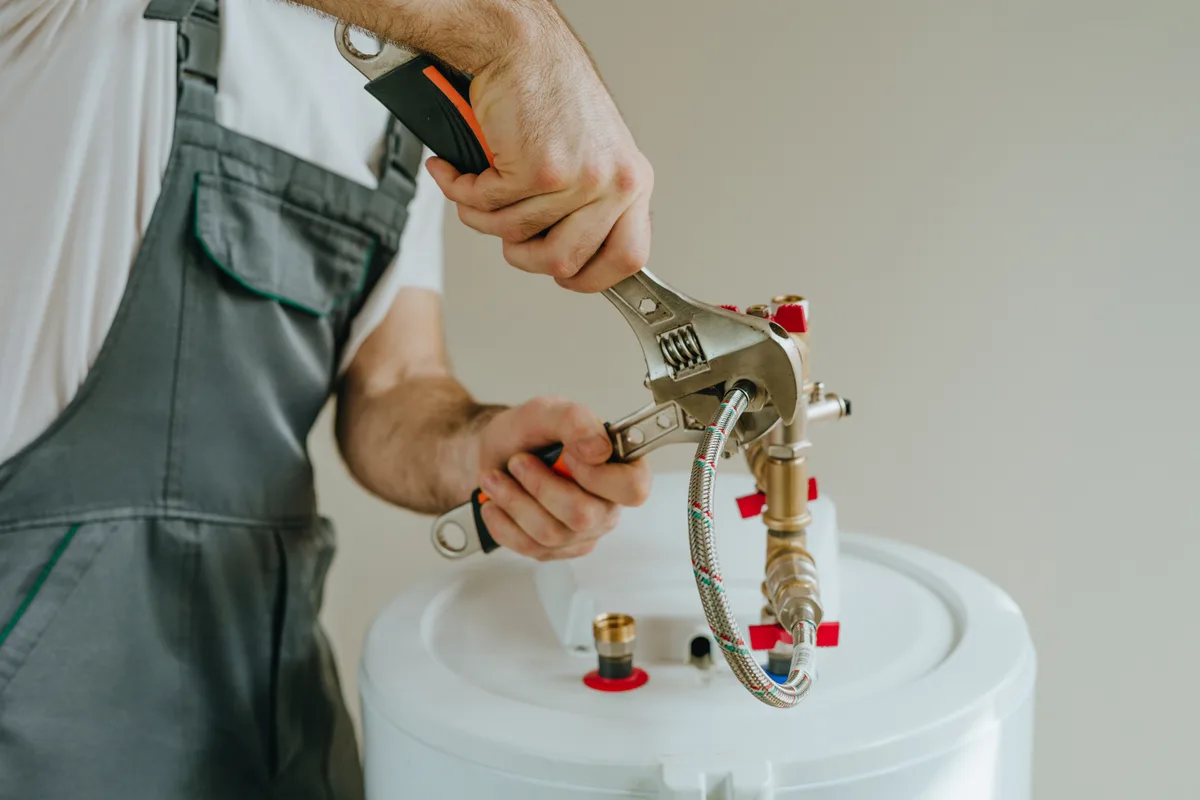
At a tank water heater: the inlet valve, nipples and heat traps
- A partly closed shut-off valve on the cold inlet. All the hot water in the house passes through this one valve first. A ball valve is fully open when the lever is in line with the pipe. Older gate valves with a round handle should be turned fully counter-clockwise, and they fail internally: the gate drops off the stem, so the handle turns freely while the valve stays half shut. A valve that was closed for a repair and never fully reopened is the easy win.
- Scale and rust in the outlet nipple. The short threaded nipples on top of the tank are where steel, copper and hot hard water meet, and they corrode from the inside until the opening is a fraction of its size. The hot outlet clogs first.
- Stuck heat-trap fittings. Many tanks ship with heat traps in the nipples, a small ball or rubber flap that stops heat drifting up the pipes. Sediment jams them partly shut, sometimes with a rattle or ticking when water runs.
- Sediment carried into the hot line. After a tank flush, a water-main repair or a dip tube breaking up, debris leaves the tank and lodges in the first restriction it meets, often the mixing valve or the aerators. Weak hot flow that began the day after plumbing work fits this pattern.
At a tankless water heater: the inlet filter and a scaled heat exchanger
A tankless unit adds two restrictions a tank does not have. The cold-inlet filter is a small screen at the base of the unit that catches grit before it reaches the flow sensor, and when it clogs, hot flow drops at every tap. With the unit off and its isolation valves closed, the filter unscrews for rinsing; the owner's manual shows where.
The second is the heat exchanger. Its water passages are narrow by design, and scale narrows them further until the unit cannot pass a full shower's worth of water. Weak hot flow paired with temperature swings or a rumbling burner means it is time to read how to tell if a tankless needs descaling. A descale flush is $150–$300.
In the piping: mixing valves and old galvanized hot lines
A thermostatic mixing valve restricts flow when its inlet screens or check valves fill with scale. Because every tap downstream is affected equally, it is easy to mistake for a heater fault. Cleaning sometimes restores it; a seized valve is replaced, and mixing valve replacement covers what that involves.
Old galvanized steel pipe is the cause in pre-war brick houses and some 1950s bungalows that still have their original plumbing. Galvanized pipe rusts from the inside, and the hot lines close up faster than the cold because heat speeds the corrosion. Flow that has faded over years instead of weeks, rusty water when a tap is first opened, and hot lines worse than cold all point this way. The cure is repiping the affected runs, which is a plumber's job and not a water heater repair.
What to check yourself, and when to call
- Compare hot and cold at three fixtures on different floors.
- Remove and rinse the aerator on the weakest tap.
- Confirm the valve above the water heater is fully open.
- Check any other valves on the hot outlet, the mixing valve and a recirculation line if you have one.
- On a tankless, clean the cold-inlet filter.
- Think back to when it started: after a repair, after a flush, or gradually.
Call for service if:
- The inlet valve handle spins without stopping or will not move. Forcing a seized valve can snap the stem and start a leak.
- The fittings on top of the tank are crusted with rust or white scale, or are damp.
- Hot flow dropped suddenly and the tank is past 10 years, since debris from a failing dip tube or anode may be the source.
- A tankless shows an error code along with the weak flow.
A diagnostic visit is $90–$150, and it is folded into the repair when you proceed. Replacing an inlet valve, the nipples or a mixing valve falls inside the $150–$800 repair band, with the figure in writing before any pipe is cut. On a gas heater, anything that means moving or disconnecting the gas line is done by a TSSA-licensed technician.
ZK Mechanical clears hot-side restrictions on tank and tankless heaters across Burlington, Oakville, Milton, Hamilton and Etobicoke. The water heater service page describes the repair visit, and the water heater answers hub has the neighbouring problems. To book, call (647) 801-1252 or message us through the contact page.