
Quick answer
A water heater mixing valve is bad when hot water is lukewarm or swings between warm and hot at every tap, when it suddenly runs scalding, or when hot flow drops while cold stays strong. Confirm it by temperature: the pipe leaving the tank should be about 60 °C and the mixed outlet no more than 49 °C. A wrong or unsteady mixed reading means the valve.
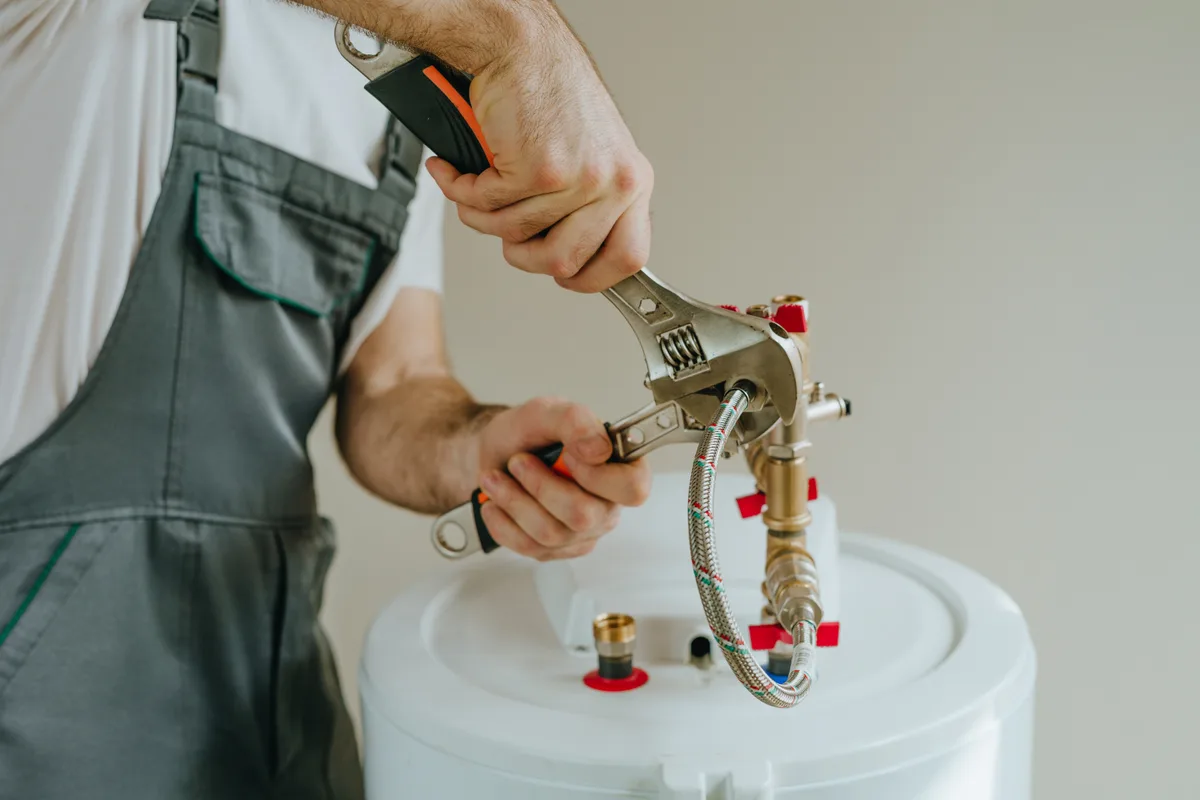
You know your water heater mixing valve is bad when the whole house shows the same hot-water fault at once and the tank itself is still heating normally. The valve is the brass three-port fitting on top of the tank, with ports marked H, C and M, that blends stored hot water with cold before it reaches any tap. Because every hot tap is fed through it, a failing valve never affects one bathroom alone.
Symptoms of a failing mixing valve at the tank
- Lukewarm water at every hot tap, while the pipe between the tank and the valve is too hot to hold. The valve is stuck toward cold, or an internal check has failed and cold is crossing into the hot line.
- Temperature that drifts up and down during a shower with nobody else using water. The thermostatic element is sticking and overcorrecting.
- Sudden scalding water. The element has failed toward hot and the house is getting stored-temperature water, which is urgent in a home with children or older adults.
- Weak hot flow at every fixture while cold pressure is normal. Scale has narrowed the passages or clogged the inlet screens.
- Turning the adjustment cap changes nothing, because a seized cartridge does not respond.
One fixture misbehaving is that fixture's own cartridge, not the tank valve. And if the pipe leaving the tank is itself only warm, the heater is the problem: start with why hot water is only lukewarm.
Why the valve is there: 49 °C at the tap, 60 °C in the tank
The Ontario Building Code limits hot water delivered to fixtures in a home to 49 °C, because water at 60 °C causes a serious burn in a few seconds. The tank, though, is kept at 60 °C, the storage temperature used to control Legionella bacteria, which multiply in lukewarm water. The mixing valve is what lets both be true. That is why turning the tank down to cure scalding is the wrong repair: it moves the tank into the range the bacteria prefer and leaves the failed valve in place.
Older installations often have no mixing valve at all. If there is no three-port valve on top of your tank, your symptoms have another cause, and what temperature a water heater should be set to is the better starting point.
How to test it: tank-outlet temperature against mixed-outlet temperature
The test is two temperatures, taken either side of the valve. A homeowner can take the mixed one at a tap; the technician takes both at the pipes.
- At a tap: run the hot tap nearest the tank for two minutes, fill a mug and read it with a kitchen thermometer. A steady 45 to 49 °C is a healthy valve.
- Under 43 °C at every tap, on a tank that has not just been emptied by heavy use: the valve is mixing in too much cold.
- Over 49 °C: the valve is not tempering. Warn the household and book the repair.
- A reading that wanders by several degrees while the tap runs untouched: the thermostatic element is failing.
- What the technician adds: a clamp-on probe on the hot pipe before the valve, expecting about 60 °C, and on the mixed pipe after it, expecting 49 °C or under, plus a cross-flow check with the cold feed to the valve isolated.
Descale, rebuild or replace an ASSE 1017 mixing valve
Scale is the usual killer. Hard water in Halton and Hamilton leaves mineral deposits on the piston and the thermostatic element, and the hottest water in the house passes through this valve all day. What happens next depends on what the technician finds inside.
- Descale: the cartridge and screens come out and soak in descaling solution. Worth doing when the valve body is sound and the element moves freely afterward.
- Rebuild: several makes sell a replacement cartridge and check valves, so the body stays soldered in place.
- Replace: when the body is pitted, no rebuild kit exists, or the valve has already been descaled once and stuck again.
- The standard to ask for: a new valve listed to ASSE 1017, the standard for mixing valves at the hot-water source, set to 49 °C with a thermometer at a tap and not by the markings on the cap.
What mixing valve work costs, and who pays on a rental
Mixing valve work falls inside the usual water heater repair range of $150–$800, depending on whether it is a descale, a cartridge or a full valve with new unions. The $90–$150 diagnostic visit is folded into the repair, and you get the figure in writing first. If the tank is rented, the valve normally belongs to the rental company, so call them before paying for parts: who pays for repairs on a rented water heater explains the split.
ZK Mechanical handles mixing valve replacement as part of its water heater service across Burlington, Oakville, Milton and Hamilton. Call (647) 801-1252 or request a visit and tell us the temperatures you measured; it shortens the diagnosis.