
Quick answer
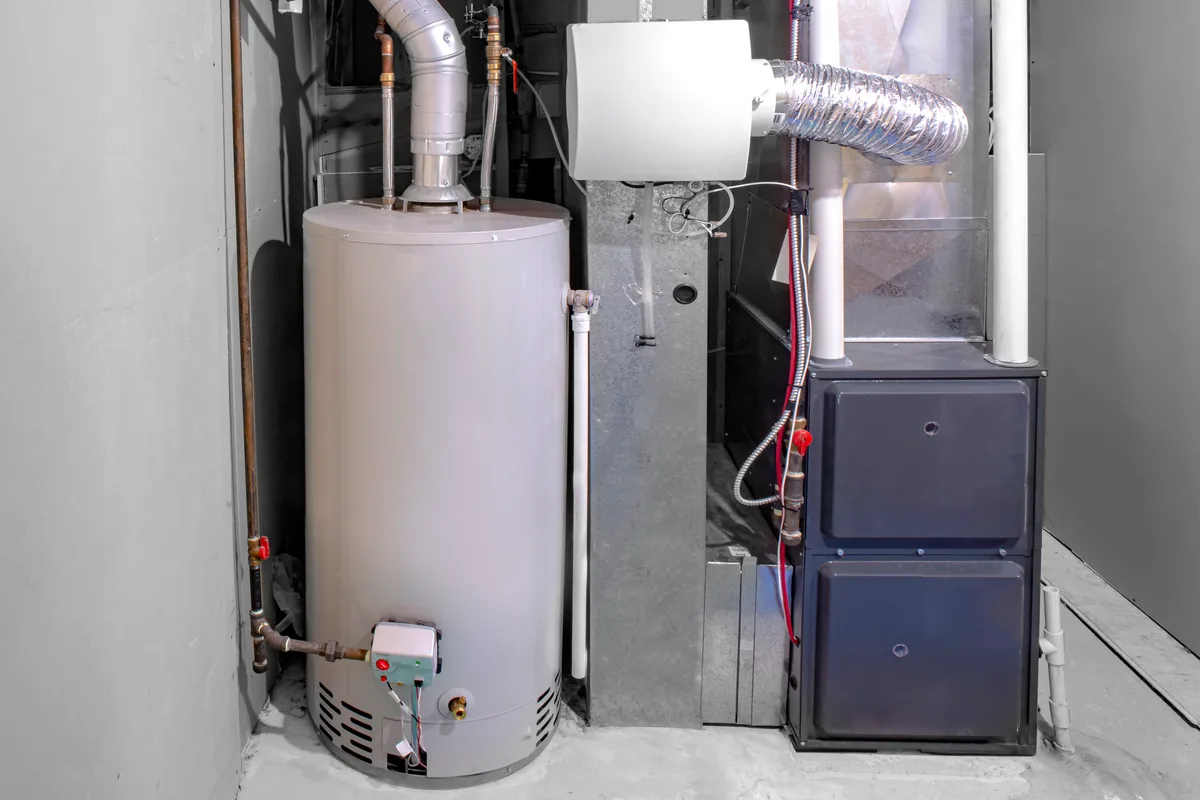
Set a tank water heater to 60°C at the tank and deliver no more than 49°C at the taps through a mixing valve. Sixty degrees keeps Legionella bacteria from growing in stored water; 49°C at the fixture keeps a child or an older adult from scalding in the seconds it takes to react. A tankless unit stores nothing, so 49°C on its display is enough.
What temperature your water heater should be set to has two answers, and the confusion between them is why so many houses get it wrong. The tank itself should store water at 60°C. The water arriving at the shower and the bathroom sink should be no hotter than 49°C. The 49°C limit is written into the Ontario Building Code for new plumbing, the 60°C storage figure is the public-health guidance that goes with it, and both are met with one small part that a lot of older houses in Burlington, Oakville and Hamilton never got.
Why 60°C at the tank
Legionella and similar bacteria multiply in lukewarm stored water, and a tank set to a comfortable 45°C is an ideal incubator, especially at the cooler bottom of the tank where the incoming water pools. At 60°C they cannot survive, which is why the code and public-health guidance settle on that number for storage. This is the reason we do not recommend turning the dial down to stop scalding: you trade a burn risk for a bacterial one.
Why no more than 49°C at the tap
Skin burns in a few seconds at 60°C and in several minutes at 49°C, and that gap is the whole safety margin for a toddler who turns the wrong handle or a grandparent whose reaction time has slowed. Since 2004 the Ontario Building Code has capped hot water at the fixtures of new houses at 49°C, which in practice means a thermostatic mixing valve on the hot line, blending cold into the 60°C supply so the taps never see more. Dishwashers and laundry can be plumbed ahead of the valve so they still get the hotter water.
The mixing valve most pre-2004 houses are missing
Almost every house built before that rule — the 1970s–90s subdivisions of Millcroft, Tyandaga and Glen Abbey, the older brick streets of Westdale and Old Oakville, and the 1950s–60s bungalows of Aldershot — has no mixing valve at all. Whatever the tank is set to arrives at the tap. If you have young children or an older parent at home and one of these houses, adding a mixing valve at the tank is a small plumbing job and it lets you run the tank at the safe 60°C without worrying about the bath. It is worth asking about during any water heater service visit.
Where the setting is on your heater
- Gas tank with a dial — the control knob at the bottom is marked with letters or Warm, Hot and Very Hot rather than degrees. On most Honeywell-style controls the notch labelled Hot is about 49°C, the letters A and B step up from there, and B is about 60°C; the label under the cover gives the exact mapping for your model.
- Gas tank with a digital control — set it directly; many default to 49°C from the factory and need to be raised to 60°C once a mixing valve is in place.
- Electric tank — there are two thermostats, upper and lower, behind screwed-on panels and insulation. Switch off the breaker before opening them, set both to the same temperature, and expect a couple of hours before you feel the change.
- Tankless — enter it on the wall controller. Because nothing is stored, 49°C is safe and avoids the hot-then-cold swings a higher setting can cause on some units.
Does turning it down save money?
A little, and only through standby loss — heat leaking through the jacket while the tank waits. On a gas tank the saving from dropping from 60°C to 49°C is real but modest, and not worth the bacterial trade-off; better insulation on the hot pipes and a shorter shower do more. An electric tank on Burlington Hydro, Oakville Hydro or Alectra Utilities has a bigger lever available: the ultra-low overnight rate plan. Put the tank on a timer so it reheats between 11 p.m. and 7 a.m. and it runs on the cheapest power of the day while still holding 60°C.
If you are going away for more than a few days, the Vacation or Pilot setting on a gas tank drops the burner while keeping the pilot lit, and an electric tank can be switched off at the breaker. Set it back to 60°C the evening you return and let it run a full cycle before anyone bathes.
A tank running at 60°C also has more usable hot water to give than one at 49°C, which matters if you find yourself asking why the hot water runs out so fast. ZK Mechanical recommends 60°C with a mixing valve on the outlet for every tank we install in Burlington, Oakville and Hamilton, and we can add one to an existing heater — ask us about it here.