
Quick answer
A furnace blower that will not turn on usually has a failed run capacitor, a seized motor, a dead ECM control module or a faulty blower relay on the control board. If the burners light and no air comes from the vents, the high-limit switch will shut the burners down. Switch the furnace off and book a repair; do not keep resetting it.
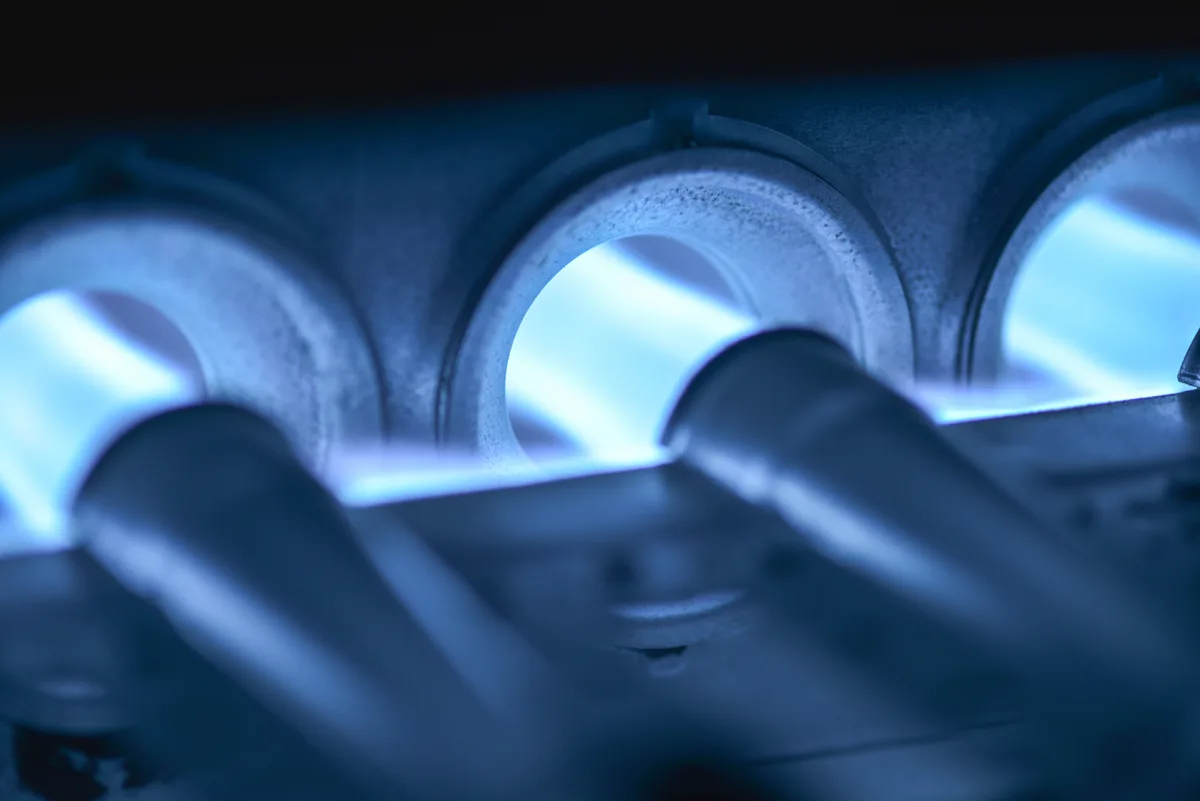
If your furnace blower is not turning on, the first thing to establish is whether the burners are lighting without it. A furnace starts in a fixed order: the small inducer fan, the igniter, the burners, and then, roughly half a minute later, the main blower that pushes warm air through the ducts. When that last step never happens, heat builds in the cabinet with nowhere to go. The furnace protects itself, but only for so long.
What happens when the burners light and no air moves
The heat exchanger overheats and the high-limit switch opens, which shuts the burners off. With a dead blower the cabinet cools slowly, the limit closes again, the burners relight, and the cycle repeats every few minutes. You hear the furnace fire, feel nothing at the registers, and may notice a hot, dusty smell near the unit.
Each of those cycles takes the exchanger well past its design temperature and lets it cool again. Repeated overheating is how heat exchangers crack and how limit switches wear out. Many control boards lock the furnace out after several limit trips in a row. If yours keeps trying, stop it yourself: set the thermostat to Off and flip the furnace service switch.
The four parts that stop a furnace blower
- Run capacitor. On a PSC motor the capacitor supplies the phase shift the motor needs to start and run. When it fails, the motor hums and stays still, or starts slowly and overheats. It is the least expensive blower repair.
- The motor itself. Bearings dry out and seize, and windings burn open. A seized PSC motor hums, trips its internal overload and often smells hot.
- ECM control module. Variable-speed and constant-torque motors carry an electronic module bolted to the end of the motor. Power surges and age kill the module, and the motor then does nothing at all, or starts, stutters and stops.
- Control-board blower relay. The board switches the blower on after a fan-on delay. A burnt relay or a failed delay circuit means a healthy motor never gets power.
The thermostat fan test that separates board, motor and wiring
Set the thermostat's fan switch from Auto to On and wait a minute. That sends a signal down the G wire asking the board to run the blower with no heat involved. During a heat call the board ignores G and starts the blower on its own timer, so the two modes test different parts of the circuit:
- Blower runs in On but never during a heat call: the motor is fine. The fault is the board's heating fan relay or delay, or the wiring to the heating speed tap.
- Blower runs during a heat call but not in On: the motor and the board's heating side are fine. The fault is the G wire, its terminal or the thermostat.
- Blower runs in neither mode: the capacitor, the motor or the ECM module has failed, or the board is sending no power at all.
Check this yourself first, and call now if the furnace fires with no airflow
- Do the fan On test and write down the result.
- Look at the filter. A filter packed solid can cut airflow so far that it feels as though the blower is off when the motor is running.
- Listen at the lower furnace door during a heat call. A hum with no rush of air points to the capacitor or a seized motor; silence points to the board, the module or the wiring.
- Read the light on the control board through the sight glass in the door and count the flashes. A limit-open code confirms the burners are overheating.
- Leave the blower door on. Do not reach in to spin the wheel: the capacitor holds a charge and the motor can start without warning.
Those checks are safe with the furnace doors closed. Stop checking and call now if any of the following is true:
- The burners light and shut off over and over with no air at the vents.
- You smell hot metal, scorched dust or electrical burning at the furnace.
- The breaker trips at the moment the blower should start, which is covered in why a furnace keeps tripping the breaker.
- The blower wheel scrapes, squeals or thumps when it does try to turn.
In each of those cases, switch the furnace off at the thermostat and the service switch and leave it off. A furnace with no blower is not a furnace you can nurse through the night by resetting it.
What a furnace blower repair costs
- Service call to find the fault: $90–$150, applied to the repair when you proceed.
- Run capacitor: $250–$500.
- Blower motor: $500–$1,500. A PSC motor sits at the low end; an ECM motor or module sits at the high end.
- Control board: $500–$1,200.
The part-by-part breakdown is in how much a furnace blower motor costs. On a furnace past 15 years old, a quote for an ECM motor is worth weighing against replacement, and a straight answer on that is part of the visit.
A technician tests the capacitor with a meter, checks for voltage at the motor and reads the motor's amp draw before recommending a part. ZK Mechanical's TSSA-licensed technicians handle furnace repair across Burlington, Oakville, Hamilton and the west GTA, with the price in writing before work starts. Call (647) 801-1252, day or night, or request a visit; other airflow and no-heat questions are answered in the heating answers hub.