
Quick answer
Running a furnace without a filter for a few hours, or overnight until the store opens, will not hurt it. Running it for days will: dust coats the blower wheel, the secondary heat exchanger on a high-efficiency furnace and the AC coil, and each is an expensive cleaning. Any correctly sized MERV 8 filter is a better stopgap than none. Never run unfiltered during renovation or sanding.
Is it safe to run your furnace without a filter? For one night, yes; as a habit, no. The filter is there less to clean the air you breathe than to keep dust out of the furnace itself. Take it out and the furnace runs normally, even a little more freely, while everything downstream of the filter slot collects what the filter would have caught.
How long a furnace can run with no filter
A few hours to one night is fine in an ordinary, occupied house. If the old filter fell apart on a January evening, run the furnace and buy a filter in the morning. A weekend is pushing it. A week or more, with pets, carpet and normal foot traffic, leaves a visible layer of dust on the blower wheel.
Two situations shorten that to zero. During drywall sanding, floor refinishing or demolition, the furnace should be off or filtered, because gypsum and wood dust are fine enough to travel deep into the heat exchanger; why a furnace stops after a renovation shows what that does. And if the filter is out because it was soaked or black with soot, the reason it got that way matters more than the empty slot.
What gets fouled when there is no filter
- Blower wheel. Dust packs into the curved blades of the squirrel-cage wheel and flattens their profile, so the same motor moves less air. Less airflow means a hotter heat exchanger, limit-switch trips and a noisier furnace. Blower compartment cleaning runs $75–$150 as an add-on, while a blower motor worn out by years of running dirty is $500–$1,500.
- Secondary heat exchanger. On a high-efficiency furnace, return air passes through a finned coil that looks like a car radiator before it reaches the main exchanger. Lint mats on its face where nobody can see it without pulling the blower, and cleaning it is a tear-down job quoted in writing.
- AC evaporator coil. The coil above the furnace is wet all summer, and dust that reaches it turns into a felt-like mat on the underside. Cooling capacity drops and the coil can freeze. Coil cleaning is priced on site because access varies so much from one installation to the next.
- Flame sensor and burners. The filter does not sit in the burner's air path, so this one is indirect: a furnace that draws its combustion air from a dusty basement coats the flame sensor until the burners light and drop out. A flame sensor cleaning or replacement is $150–$300.
- Ducts and registers. Whatever is not caught settles in the supply trunk and blows out as grey dust on the furniture.
A better stopgap than no filter at all
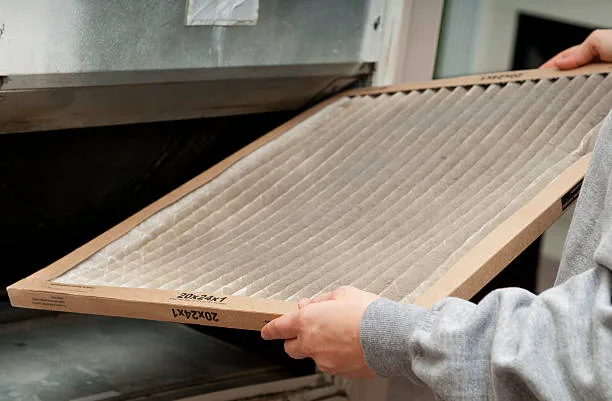
Almost any filter beats an empty slot. The best quick fix is a basic pleated MERV 8 in the size printed on the old filter's frame or on the furnace's filter door, and every hardware store carries the common sizes. If your size is not on the shelf, a cut-to-fit filter pad trimmed to the rack does the job for a few weeks. The furnace filter sizes guide explains how to read the dimensions.
- Do use a thinner or lower-MERV filter of the right length and width if that is all the store has.
- Do vacuum the dirty face of the old filter and put it back for a night if it is intact and dry.
- Do not wedge in a filter that is too small. Air takes the gap and carries the dust with it.
- Do not stack two filters or buy the highest MERV on the shelf to make up for lost time. Too much resistance starves the furnace, as can a furnace filter be too restrictive explains.
- Do not reuse a filter that has been wet.
Check first whether the furnace really has no filter
Before you assume the slot is empty, look in two places. Most furnaces have an external rack between the return duct and the cabinet, with a narrow cover or an open slot. In older bungalow installations the filter often sits inside the blower compartment, held against the cabinet opening by a wire clip, and people who do not find a slot conclude there is no filter.
- Switch the furnace off, open the lower door and look for a filter standing against the side or bottom opening.
- Check the return-air grilles in the hallway or ceiling. Some houses filter at the grille, not at the furnace.
- Look for a thick box on the return duct: a 4- or 5-inch media cabinet holds a filter that lasts 6 to 12 months and is easy to forget.
- If there truly is no rack, a filter cabinet can be added on the return duct so a standard size fits without gaps.
Signs the furnace has already run unfiltered too long
- Weak airflow at the registers with a clean filter in place.
- The furnace shutting off partway through a cycle and restarting a few minutes later, which is the limit switch.
- A dusty or scorched smell that does not clear after the first few cycles.
- Grey fuzz on the blower wheel when you look in with a flashlight, power off first.
- The AC icing up the following summer.
None of these is an emergency, but each means the dust is now inside the machine and a filter change will not bring the airflow back. Call sooner if the furnace is tripping its limit again and again, because repeated overheating is hard on the heat exchanger. A tune-up at $120–$250 is the visit that measures it: temperature rise across the furnace and static pressure in the ducts show whether the blower and coils are restricted. Manufacturers also expect a filter to be in place, so dirt damage is not something to count on a warranty covering.
If the furnace has been running bare for a while, ZK Mechanical can pull the blower, clean what the filter should have protected and measure the airflow afterwards. Call (647) 801-1252 or book a visit for furnace repair and cleaning. The other filter questions sit with the rest of our heating answers.