
The problem
The tank runs out mid-shower, it occupies a corner of the basement that could be storage, and once it is past a decade it is a leak waiting for a weekend. A tankless conversion answers all three, but it is a conversion rather than a swap: a 199,000 BTU tankless burner pulls roughly five times the gas of a 40,000 BTU tank, so the gas line, the venting and the water piping all change. A quote that treats it as a like-for-like exchange has not looked at the gas line.
What we did
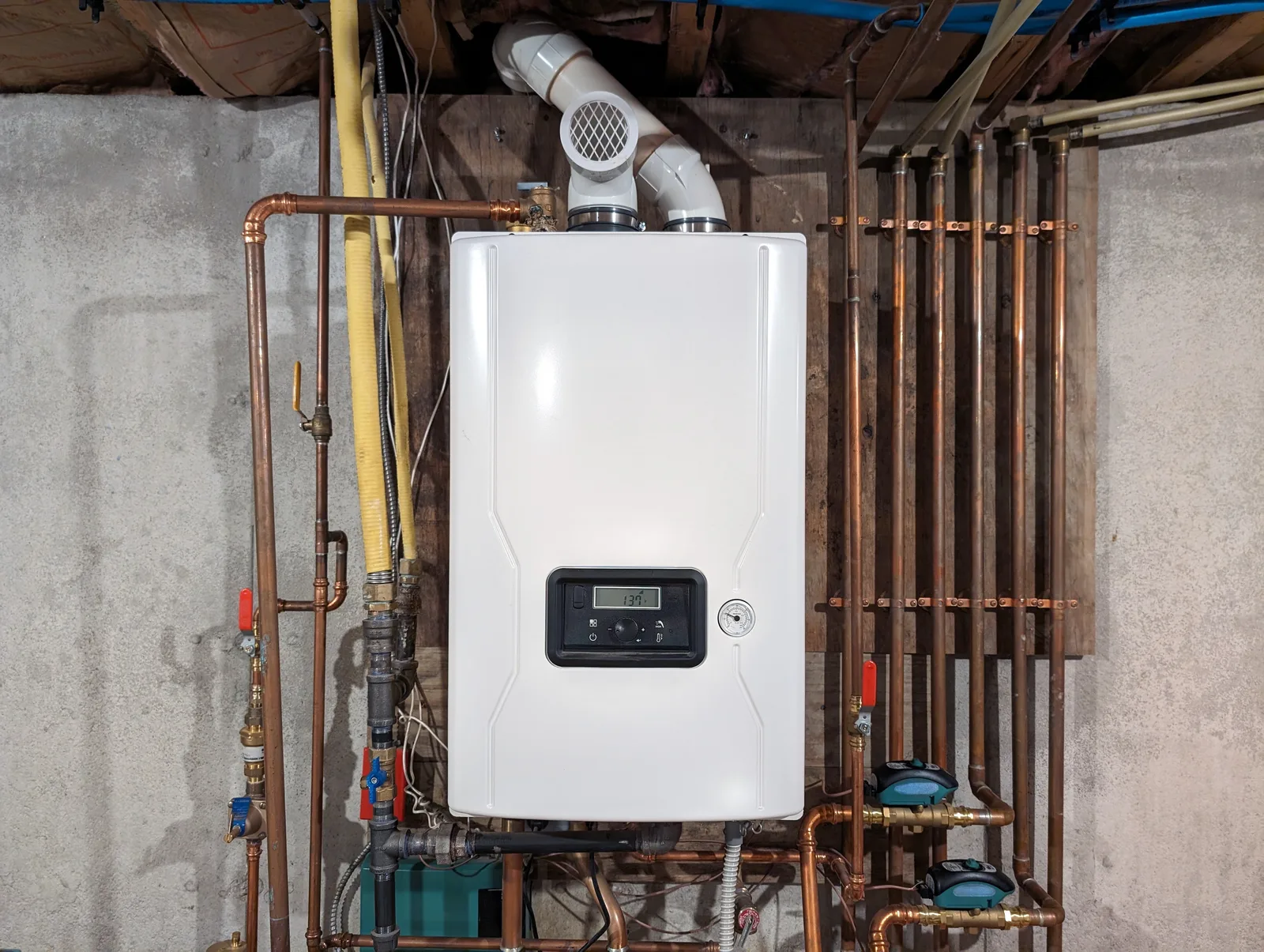
The unit in the photo is wall-mounted with new copper water piping and isolation valves with service ports — the fittings that turn a future descale into a 20-minute vinegar flush instead of a plumbing exercise. The gas line is sized for the burner from the CSA B149.1 pipe-sizing tables rather than inherited from the tank, which typically adds $400–$1,200 when the run has to be upsized, and a TSSA-licensed technician makes the connection and leak-tests it. Venting is dedicated ULC S636 pipe run within the manufacturer's length limits, and on a condensing model the acidic condensate passes through a neutralizer before the drain.
- Wall-mounted gas tankless water heater
- Copper water piping and isolation valves
- Upsized gas connection
- Dedicated venting
The result
Endless hot water, a reclaimed corner of the basement, and a unit with a service life in the 15-to-20-year range against eight to 12 for a tank. On moderately hard water, an annual descale flush through those isolation valves is what keeps the heat exchanger efficient.
Is this your situation?
This kind of work is worth a conversation if any of these sound familiar:
- The tank runs out of hot water partway through normal household use.
- Your water heater is past a decade and you would rather replace it than wait for the leak.
- You want the floor space in the mechanical room back.
- You are prepared for a real conversion — gas sizing and venting included — rather than a like-for-like swap.
Questions about this kind of job
Why does a tankless heater need a bigger gas line than the tank had?
A tank heats water slowly with a small burner, typically around 40,000 BTU per hour. A whole-house tankless unit heats water on demand with a burner near 199,000 BTU per hour, so it needs roughly five times the gas flow at the same moment. Pipe size is worked out from the CSA B149.1 sizing tables using the run length and every other appliance on the meter.
What are the isolation valves for?
They are a pair of shut-offs with service ports on the hot and cold connections. Closing them and connecting a small pump lets a technician circulate a descaling solution through the heat exchanger without draining the house plumbing. Without them a descale means cutting pipe. On hard water an annual flush through those ports is what keeps the unit from throwing a flow or overheat code.
Will a tankless unit keep up in winter?
Output depends on how far the unit has to raise the incoming water temperature. Cold-water inlet temperature drops to single digits Celsius in winter, so the same unit delivers fewer litres per minute at a given shower temperature than it does in August. Sizing is done on the winter inlet temperature and the number of fixtures that run at once, not on summer conditions.
Does a tankless water heater need a different vent?
Yes. Condensing tankless units vent in plastic pipe, either twin-pipe or concentric, certified to ULC S636 and run within the manufacturer's maximum length, with termination clearances to windows, grade and the gas meter set by CSA B149.1. The old tank's chimney or B-vent cannot be reused for it, and if another appliance still uses that chimney, its draft has to be reassessed.