
The problem
An outdoor unit set at grade spends February buried in drifted snow and April standing in meltwater. For an air conditioner that is a corrosion and service-access problem: the base pan rusts, the bottom rows of coil fins pack with ice and grit, and the service valves are under a snowbank when a technician needs them. For a heat pump it is worse, because the unit runs all winter and sheds defrost water out of its base pan. If that pan sits in a puddle that refreezes each night, the coil ices from the bottom up, defrost cycles run longer, and capacity drops on exactly the coldest nights.
What we did
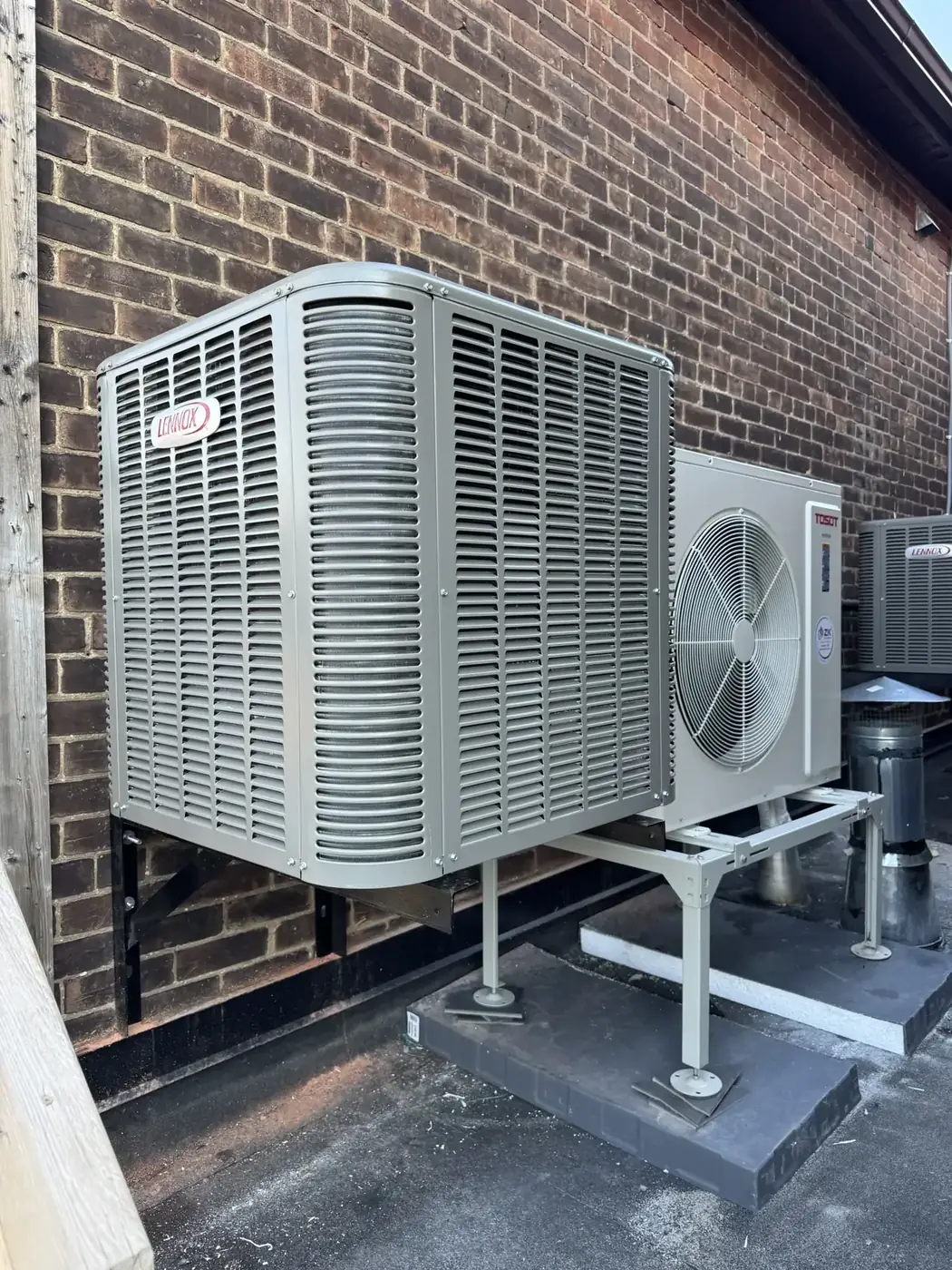
Raising the equipment on a stand above the expected drift line solves all of it at once, and costs little when done at installation instead of retrofitted with the line set already brazed. The photo shows Lennox outdoor units on elevated stands with clear space underneath for defrost water to drain away and refreeze somewhere harmless, and enough height that the service ports and disconnect stay reachable. Stand height is chosen for the exposure of the site — a sheltered side yard and a wind-swept open lot are not the same problem — and the line set gets a gentle service loop rather than a hard bend at the new elevation.
- Lennox outdoor condensing units
- Elevated equipment stands
- Service clearance and disconnects
The result
Coils that stay clear through the winter and dry in the spring, fewer nuisance defrost faults, and service access that does not begin with digging the unit out. On heat pump installations this is treated as standard rather than an upgrade, because a unit that ices up in January undoes the whole reason it was chosen.
Is this your situation?
This kind of work is worth a conversation if any of these sound familiar:
- Your outdoor unit disappears under drifted snow every winter.
- A heat pump ices up or struggles on the coldest nights.
- The unit sits in meltwater each spring, or the base pan has rusted.
- The property is exposed — an open lot, a wind-swept side yard, or above the escarpment.
Questions about this kind of job
How high should a heat pump be mounted off the ground?
Above the snow depth the site sees in a bad winter, plus enough clearance for defrost water to drain and not refreeze against the base pan. The stand or wall bracket has to be rated for the unit's weight and anchored so wind cannot rock it, and the line set and drain need a service loop rather than a hard bend where they leave the cabinet.
Why does a heat pump produce water in winter?
In heating mode the outdoor coil runs below freezing and frost builds on it from the moisture in the air. Every so often the unit reverses briefly to melt that frost, and the meltwater runs out of the base pan. If it cannot drain away it freezes into a block that grows up into the coil, and the unit spends more of each hour defrosting instead of heating.
Does an elevated stand help an air conditioner too, or just a heat pump?
It helps both. An air conditioner does not run in winter, but its condenser still sits in drifted snow, spring meltwater and road-salt spray, which corrodes the base pan and the lower coil fins. Raising it keeps the coil dry between seasons, keeps the service valves and disconnect above the snow line, and makes the spring start-up inspection a simpler job.
Can a stand be added to a unit that is already installed?
Yes, but it is a bigger job than doing it new. The refrigerant has to be pumped down or recovered by an ODP-carded technician, the line set unbrazed or re-flared, the electrical whip lengthened, and the unit lifted, re-set, evacuated and recharged. Doing it at installation adds a stand and a few minutes; retrofitting adds most of a service visit.