
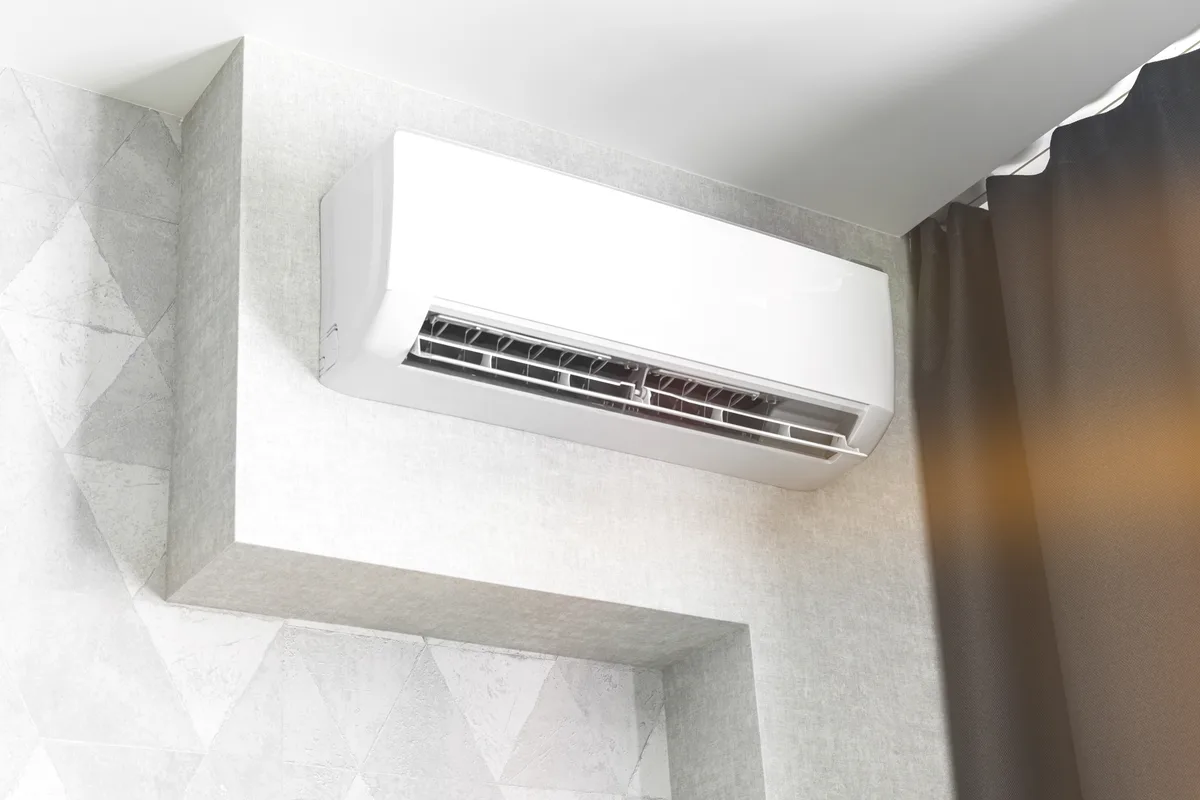
Sunroom heating and cooling options in Ontario narrow quickly once you account for the glass: a sunroom gains and loses several times more heat per square foot than the rest of the house, so a duct extended from the furnace rarely keeps up. The standard answer is a single-zone cold-climate ductless heat pump sized by calculation, at $4,000–$7,000 installed plus roughly $500–$1,500 for the cold-climate model. If the room was built as an unheated three-season room, adding permanent heat also means a building permit and meeting the Building Code's energy-efficiency rules.
Why a sunroom needs so much more heating and cooling than the house
Glass is the reason. An insulated house wall is around R-20 or better, a good double-glazed window is around R-3, and a sunroom is mostly window. Each square metre of glass loses roughly six or seven times the heat of the same area of wall on a January night.
Summer runs the other way. Sun through south and west glass heats the room directly, and the peak arrives in mid-afternoon when the remaining rooms are comfortable. The sunroom's load peaks at different hours from the house, which is why one thermostat cannot serve both.
- Glass roof panels or skylights add load faster than wall glass.
- South and west exposures drive cooling; north and east exposures drive heating.
- A floor built over a deck frame or an uninsulated slab pulls heat out from below.
- Three exposed walls lose more than a room tucked into a corner of the house.
- Aluminium frames without a thermal break run cold and collect condensation.
Why extending the furnace ducts usually fails
A duct run from the house furnace fails for three reasons. The thermostat is in the house, so the furnace shuts off when the hallway is satisfied and the sunroom is still cold. The furnace and air conditioner were sized for the house without the sunroom. And the new run sits at the far end of the trunk, where it delivers the least air and takes some from the rooms before it.
There is also no return path. A supply register in a room with a closed exterior-grade door pressurizes the room and the air stops moving. A duct can work in a true four-season addition with house-grade walls, an insulated floor and modest glass, once a heat-loss calculation shows the furnace has capacity to spare; HVAC for home additions covers that case.
The standard answer: a single-zone cold-climate ductless heat pump
A ductless heat pump gives the sunroom its own capacity and its own thermostat, heats and cools from one unit, and modulates between a low and a high output as the sun moves. It is sized from a heat-loss and heat-gain calculation for that room, never from floor area alone, because glass area and orientation dominate the result. A sunroom commonly needs a larger unit than a bedroom of the same size, and what size mini-split you need explains the inputs.
Buy the cold-climate model. The sunroom has the highest heat loss in the house at exactly the outdoor temperatures where a standard heat pump loses output, a gap laid out in cold-climate vs standard heat pumps.
- Single-zone ductless heat pump: $4,000–$7,000 installed
- Cold-climate model: add roughly $500–$1,500
- Electrical: a dedicated circuit installed under ESA rules, priced by the distance to the panel and the capacity left in it
The breakdown behind those bands is in what a ductless mini-split costs in Ontario.
Free quotes, written pricing.
Floor-mount or wall-mount: which indoor head suits a sunroom
Use a wall-mount head on the house wall when that wall has clear space near the ceiling, and a floor-mount head when it does not. In most sunrooms the only solid wall is the one shared with the house, and a patio door often takes up most of it.
- Wall-mount head: mounts high on the house wall and blows out toward the glass. It costs the least and the refrigerant lines pass straight through to the outside.
- Floor-mount head: sits low on a knee wall under the windows, provided the knee wall is tall enough for the cabinet, roughly 60 cm. It delivers heat at floor level, where cold glass creates a downdraft.
- Ceiling cassette: rarely possible, because a sunroom roof has no cavity deep enough to hold one.
- Condensate: either head needs a drain line that slopes to the outside by gravity, so plan its route before choosing the position.
- Outdoor unit: set it on a stand above the snow line and clear of the sunroom's roof edge, since glass and metal roofs shed snow and ice in sheets.
Three-season rooms: what works without converting
A three-season room can be cooled in summer and warmed in spring and fall, but it should not be held at 21°C through January. Single glazing, an uninsulated floor and unbroken aluminium frames lose heat faster than any reasonable unit can replace it, and the warm, moist air inside condenses and freezes on the glass and frames.
Use this rule. If the room has single glazing or an uninsulated floor, treat it as three-season: run the heat pump from April to November, then shut it down and keep the door to the house closed. If it has double glazing and an insulated floor and roof, year-round use is realistic.
Converting a three-season room to heated space: permits and the Building Code
Adding permanent heat changes what the room is under the Ontario Building Code. An unheated three-season room is built to lighter requirements. Once it becomes conditioned living space, expect the Code's energy-efficiency requirements for insulation and glazing to apply, along with a building permit from your municipality.
Call the building department before you buy equipment: the City of Burlington, Town of Oakville, Town of Milton and City of Hamilton each handle this at the permit desk. The answer may be that the floor, roof or glass has to be upgraded first. Keep the exterior-grade door between the house and the sunroom either way, because it lets you isolate the room in the coldest weeks.
Verdict: the right system for each kind of sunroom
- Four-season sunroom with double glazing and an insulated floor: a cold-climate single-zone ductless heat pump, used all year.
- Three-season room you are not converting: a ductless heat pump for cooling and shoulder-season heat, shut down in deep winter.
- Room you plan to convert: permit and envelope upgrades first, heat pump second.
- True addition with house-grade walls: ducts from the furnace only after a heat-loss calculation confirms the capacity.
- Electric baseboard or a radiant floor mat: a supplement for comfort underfoot, not the main system, because of the running cost.
We size sunroom systems by calculation and say so plainly when a room should not be heated through the winter. See ductless mini-split installation for how the work is done, or book a site visit and we will measure the glass before quoting.
Frequently asked questions
Can I add a vent from my furnace to heat a sunroom?
You can, but it seldom works. The furnace follows a thermostat in the main house and stops when that area is warm, the added run is at the weak end of the duct system, and the equipment was not sized for the extra glass. The usual result is a sunroom that is cold in winter, hot in summer and a house that is slightly worse off.
Will a mini-split heat a sunroom in January in Ontario?
In a four-season sunroom with double glazing and an insulated floor and roof, a correctly sized cold-climate unit holds a comfortable temperature through an Ontario winter. In a three-season room with single glazing it will run constantly, cost a great deal and still leave frost on the glass. The building decides the outcome more than the equipment does.
Is a floor-mount mini-split better than a wall-mount in a sunroom?
For heating comfort, often yes, because it puts warm air at floor level under the cold glass. It costs somewhat more and needs a knee wall tall enough to hold the cabinet. A wall-mount head on the house wall is the simpler installation and cools very well. The room's layout usually makes the decision.
Do I need a permit to put a mini-split in my sunroom?
The electrical circuit is installed under ESA rules by a licensed electrician. The bigger question is the room itself: if it was built as an unheated three-season room, making it heated living space is a change your municipal building department will want to review. Ask them before the install, not after an inspector notices.