
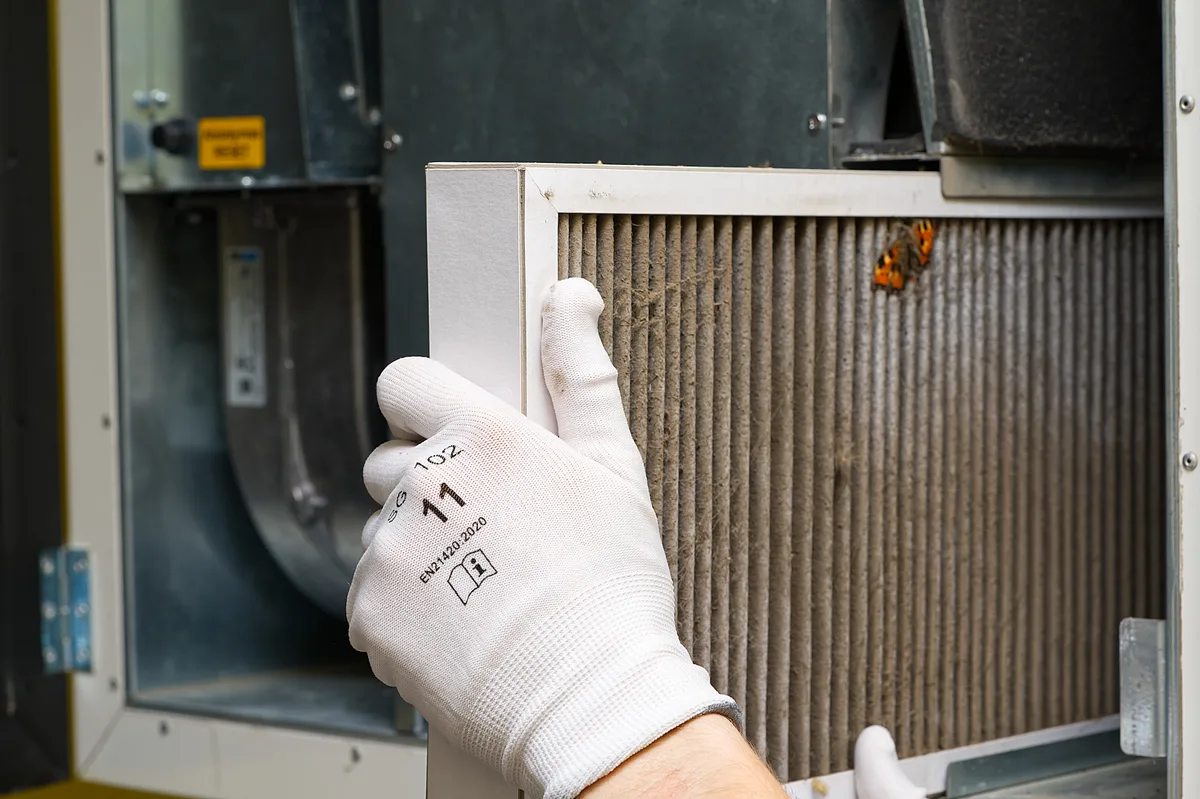
Condo fan coil replacement is a choice between two jobs: a retrofit insert that rebuilds the unit inside its existing cabinet, or a full replacement that takes the cabinet out of the wall. Choose the retrofit when the cabinet and the riser connections are sound, which covers most suites, and the full replacement when the cabinet has rusted through or the building is replacing its risers. Before either, read your declaration to see who pays, and ask management how riser shut-offs are booked.
What a fan coil is and why it gets replaced
A fan coil is a blower, a water coil, a filter and a drain pan in a steel cabinet, fed with hot or chilled water from the building's central plant. It usually stands in a closet or is built into a wall beside the window. The machine is simple, and the motor is rarely the reason it comes out.
The usual trigger is mould. Older cabinets are lined with fibreglass insulation that gets damp from the cooling coil, holds dust and grows mould, while the drain pan below it rusts and overflows. These are the signs that the unit is past cleaning.
- A musty smell when the fan starts in cooling season.
- Black spotting on the liner behind the filter or on the supply grille.
- Rust flakes or standing water in the drain pan, or a stain at the base of the cabinet.
- A liner that crumbles or sheds fibres when touched.
- A fan that hums, rattles or works on one speed only.
A blocked drain or a failed motor in a clean cabinet is a repair. A wet, mouldy liner in a unit from the building's original construction is a replacement, because a fibreglass liner that has been soaked cannot be washed back to clean.
Two-pipe or four-pipe: how to tell which your building has
A two-pipe building sends either hot or chilled water to every suite through one supply riser and one return riser, and the corporation switches the whole building over in spring and fall. A four-pipe building runs separate heating and cooling risers, so each suite can heat or cool on any day of the year. The replacement has to match, because the coil, the valves and the controls differ.
- Notices: a seasonal changeover notice from management means two-pipe.
- Count the pipes behind the access panel: two insulated water pipes plus a small drain line is two-pipe; four plus a drain is four-pipe.
- Behaviour: if the unit will only heat in October whatever the thermostat says, the building is two-pipe and still in heating mode.
- Electric heat: some two-pipe units carry an electric heater for the weeks around changeover, with its own breaker in your panel.
- The sure way: ask the property manager, who has the mechanical drawings.
Retrofit insert versus full unit replacement
A retrofit keeps the steel cabinet in the wall and replaces what is inside it. The insert is built to the dimensions of the original cabinet and brings a new coil, drain pan, fan and motor, new controls and a closed-cell liner that does not hold water the way fibreglass does. The drywall stays, and the connection points to the risers are reused.
A full replacement removes the cabinet. The wall is opened, the old unit is cut out and a new one is connected and closed in. In many towers the risers run through or directly behind the cabinet, so a full replacement means working on the building's own piping, which makes it a job for the corporation to coordinate, not a single owner.
- Retrofit suits: a sound cabinet with surface rust at most, risers and isolation valves in working order, and an insert available for that make and size.
- Full replacement suits: a cabinet rusted through at the base, a building-wide riser replacement, or a unit with no retrofit made for it.
- Either way, ask for an electronically commutated (ECM) fan motor, which is quieter and uses less electricity than the original motor.
- Confirm the thermostat: older units use line-voltage controls, and the new unit may need a different thermostat and wiring.
Free quotes, written pricing.
Who pays: the owner or the corporation
The declaration decides. Every Ontario condominium's declaration and by-laws define where the unit ends and who maintains and repairs what, and fan coils fall on either side of that line depending on the building. In many, the fan coil is part of the unit and the owner maintains and replaces it, while the risers and the central plant are common elements. In others the corporation owns and services every fan coil.
Get the answer in writing from the property manager before you ask for quotes, and ask two more questions at the same time. Does the corporation require a specific model or an approved contractor, and is a building-wide replacement program planned? Our answer on who is responsible for a condo fan coil unit covers the usual split, and condo board approval for HVAC work covers the paperwork.
Responsibility also follows the water. If your drain pan overflows into the suite below, the repair to that ceiling can come back to you through the corporation's insurance deductible. That is the financial case for replacing a rusted pan before it leaks.
Booking the work: riser shut-offs, elevators and insurance
The riser shut-off is the step owners do not expect. Changing a coil or its valves means the water to the unit has to be off. If the unit's own isolation valves are present and hold, the work stays inside your suite. If they are seized, leaking or missing, the building has to shut and drain that riser, which affects every suite on the stack and has to be booked with management in advance.
- Ask management how much notice a riser shut-off needs and whether the corporation charges for it.
- Have the isolation valves replaced while the riser is down, so the next repair does not need another shut-off.
- Expect the building to ask for the contractor's certificate of insurance before work starts.
- Book the service elevator and confirm the permitted working hours.
- In a two-pipe building, schedule around the changeover so the suite is not without heating or cooling in the season you need it.
What drives the price of a fan coil replacement
We do not publish a flat price for fan coil replacement, because the building sets as much of the cost as the unit does. A written quote follows a look at the cabinet, the valves and the building's requirements. A diagnostic visit is $90–$150, folded into the repair if you proceed.
- Retrofit insert or full replacement, and how much drywall and finishing is involved.
- Unit size, and two-pipe versus four-pipe.
- The state of the isolation valves, and whether a riser shut-off is needed.
- Controls: a new thermostat, control valve or wiring.
- Access: a closet unit with a door is quicker than one boxed in behind millwork.
- Volume: several units in one suite, or a building program, lowers the cost per unit.
Verdict: retrofit for most suites, full replacement when the cabinet has failed
- Choose a retrofit insert if the cabinet is solid, the valves work and the complaint is mould, a rusted pan or a tired motor.
- Choose full replacement if the cabinet floor is rusted through, the risers are being replaced or no insert fits the unit.
- Join the building's program if one is planned within a year or two, unless the unit is leaking now.
- Repair only if the unit is clean inside and the fault is a drain, a valve or a motor.
We service and replace in-suite fan coils in condo buildings across Burlington, Oakville, Hamilton and Mississauga, and we deal with the property manager on shut-offs and insurance. Owners can start with condo HVAC service, boards and managers with HVAC for condo corporations. Send the make and model from the label inside the access panel when you request a quote.
Frequently asked questions
How long does a condo fan coil unit last?
Most reach the point of replacement or retrofit somewhere after 20 to 25 years, and the calendar matters less than the condition inside. A unit with a dry, intact liner, a sound drain pan and a quiet motor can keep running with regular filter changes and drain cleaning. A unit with a wet, mouldy liner is due whatever its age.
Will cleaning fix mould in a fan coil?
Cleaning the coil, the drain pan and the drain line fixes surface growth and odour for a while, and it is worth doing every year. It does not fix insulation that has been wet repeatedly. Fibreglass liner holds moisture and dust below the surface, so the smell returns. Replacing the liner, usually as part of a retrofit, is the lasting repair.
Can I replace my fan coil with a different brand or my own heat pump?
Only with the corporation's approval. The replacement has to suit the building's water temperatures, pressures and pipe arrangement, and many corporations specify approved models so that every suite on a riser behaves the same way. Swapping a fan coil for a self-contained heat pump changes how your suite uses the building's systems and is rarely permitted.
Can I stay in my suite during a fan coil retrofit?
Yes. A retrofit is done from the access panel with the cabinet left in the wall, so the disruption is limited to the area around the unit. Expect the heating or cooling to be off while the work is under way, and some noise. A full replacement involves cutting and refinishing drywall, so it is dustier and takes longer.