
Quick answer
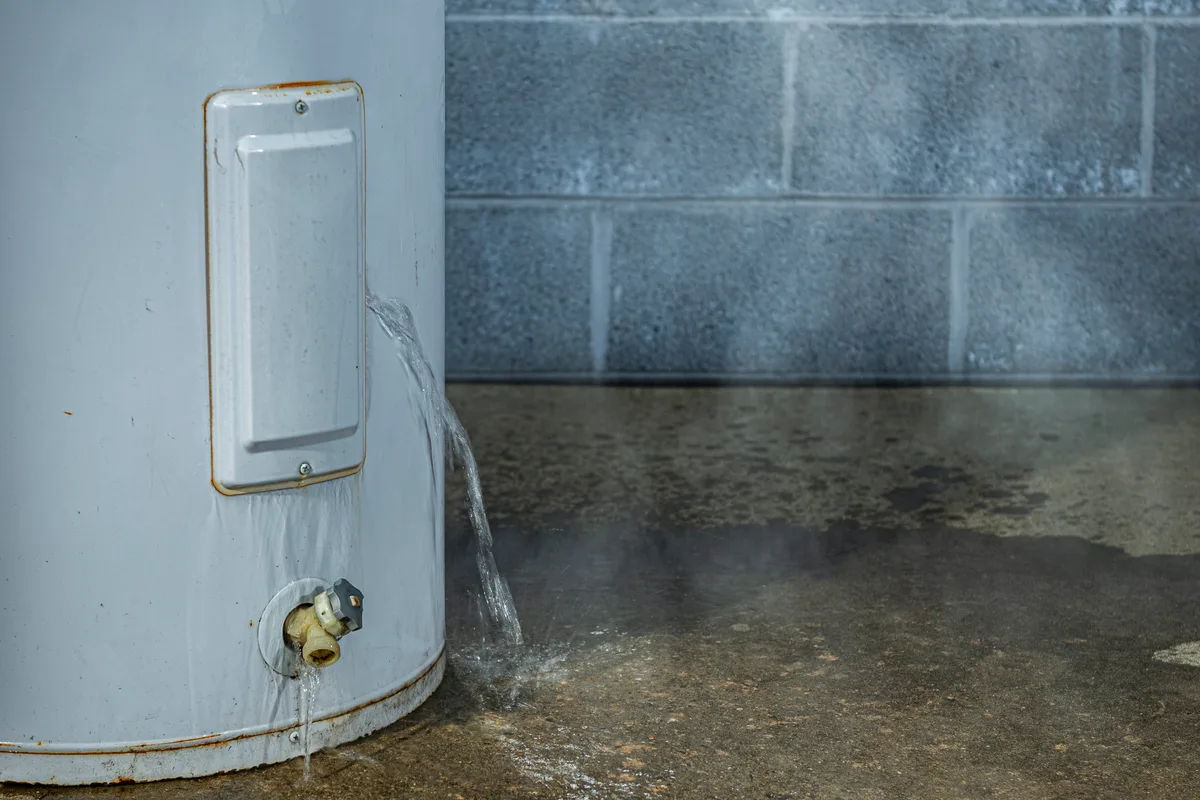
Where the water shows up tells you why your water heater is leaking. Water on top comes from the inlet and outlet fittings or a weeping relief valve — both repairable. Water at the base is a loose drain valve, cold-weather condensation, or a rusted-through tank. A tank leaking from its own steel cannot be repaired and needs replacing before it lets go.
Figuring out why your water heater is leaking starts with a paper towel and a flashlight, because the source is rarely where the puddle is. Water runs down the jacket, along the floor and under the nearest wall, so you have to find the highest wet point. Work from the top of the tank down and you will land on one of the causes below, and most of them are a small repair rather than a new tank.
Leaking from the top: fittings and the relief valve
- Cold inlet and hot outlet connections — the threaded nipples where the supply pipes meet the tank corrode from the inside, especially where copper meets the steel tank without a dielectric fitting. A drip that follows the pipe down the side of the tank almost always starts here, and new nipples and a fresh connection solve it.
- The temperature and pressure relief valve — this is the brass valve with a lever near the top, with a pipe running down to the floor. If that pipe is wet or dripping, the valve is opening. Sometimes the valve is worn and needs replacing; often it is doing its job, which is the next section.
- A power-vent tank's blower housing or vent joint — on units with a fan on top, a wet ring around the fan base is usually condensation draining back from a long, cold PVC run, not a tank fault.
Is the relief valve dripping? Pressure, not a defect
A relief valve that discharges a cup of water after every heating cycle is reacting to thermal expansion. Water grows in volume as it heats, and it used to push back harmlessly into the street main. Many homes in Halton and Hamilton now have a check valve or backflow preventer at the water meter, which turns the plumbing into a closed system with nowhere for that expansion to go, so pressure spikes until the valve opens. The fix is a small expansion tank on the cold line; our answer on whether you need an expansion tank explains how to check.
High street pressure does the same thing. Houses low in a municipal pressure zone — the lakeshore end of Burlington below the QEW, or Hamilton's lower city under the escarpment — see higher static pressure than houses near the top of the zone, and a pressure-reducing valve at the main shut-off brings it back into a safe range for every fixture, not just the heater.
Water at the base: drain valve, condensation or a failed tank
- Drain valve — the plastic spigot at the bottom weeps after it has been opened for a flush and never seals again. A brass replacement valve or a cap on the outlet is a minor fix.
- Condensation — a tank refilled with near-freezing winter water sweats heavily on the first firing, and the drips collect in the burner pan. If the floor is dry again once the tank reaches temperature, it is not a leak.
- The tank itself — steel tanks are glass-lined, and once the lining cracks and the anode rod is used up, the shell rusts through from the inside. Water seeping from the seam under the jacket, rust-coloured water at the taps, or a wet burner chamber with no fitting above it all point here, and there is no repair for it.
What to do right now
- Close the cold-water shut-off valve on the pipe feeding the tank so it stops refilling.
- Turn the gas control to Pilot or Off, or switch off the breaker for an electric tank — never heat a tank that cannot hold water.
- Attach a garden hose to the drain valve and run it to a floor drain so the basement does not take the full volume if the tank splits.
- Move stored boxes, flooring and anything electrical away from the wet area, and check the rating plate for the manufacture date while you are down there.
- If the tank is rented, photograph the leak and call the rental company; the repair or swap is their responsibility.
Repair or replace a leaking water heater?
Fittings, valves and an expansion tank are repairs, and they sit toward the low end of the $150–$800 range we publish for water heater repairs. A leaking tank shell on a heater under warranty may qualify for a manufacturer replacement of the unit itself, so keep the paperwork. A leaking shell on a tank past eight to ten years is a replacement, and a like-for-like tank swap typically runs $1,200–$2,500 installed with hot water back the same day. Our repair-versus-replacement cost analysis lays out where that line falls.
Because a tank can go from a weep to a flood overnight, we treat an actively leaking heater as a same-day call. ZK Mechanical carries common tank sizes and installs across Oakville, Burlington and Hamilton with written pricing before the old unit comes out. Send us a photo of the leak and we will tell you honestly whether it is a fitting or the tank.