
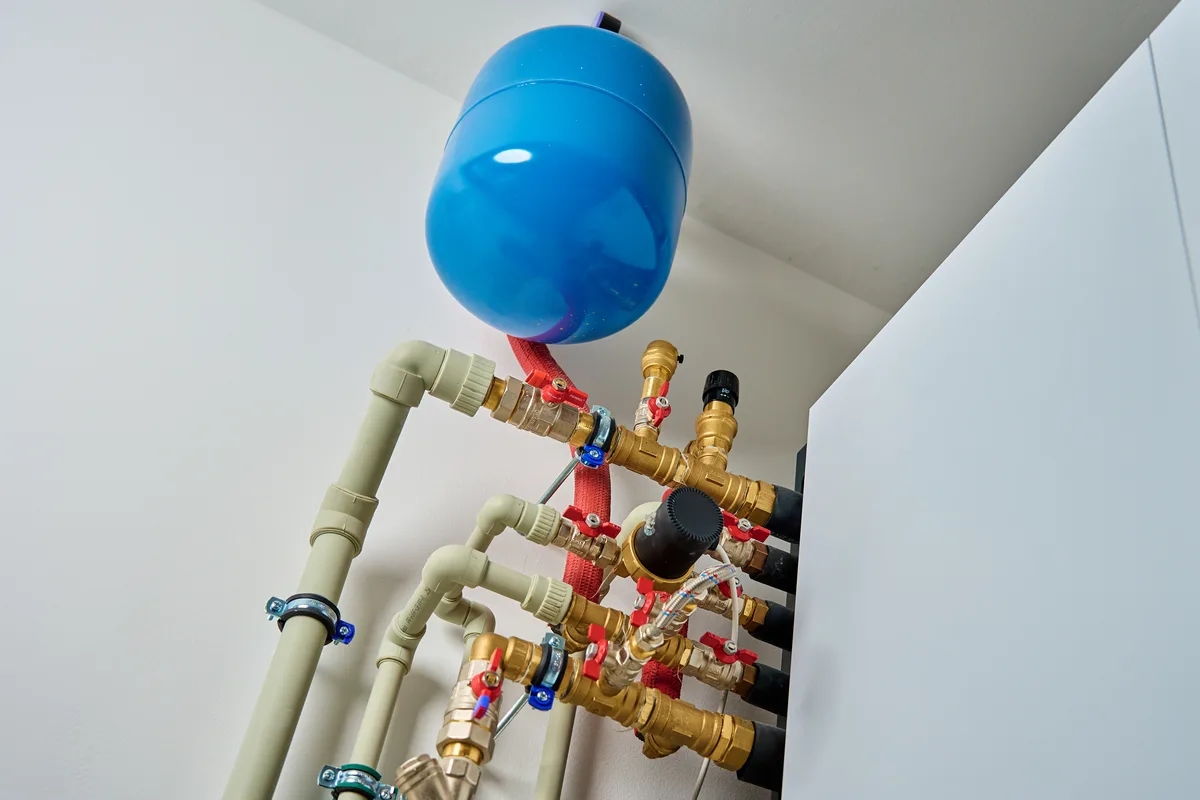
Quick answer
You need an expansion tank if your home has a closed plumbing system — a check valve, backflow preventer or pressure-reducing valve on the water service that stops heated, expanding water from pushing back into the municipal main. Many newer Halton Region and Hamilton water meters include a check valve, which closes the system. The tell-tale sign is a relief valve that drips after every heating cycle.
Do you need an expansion tank on your water heater? It depends on one thing: can the water in your pipes push back toward the street when it heats up, or is it trapped? Water expands as it warms — a 40-gallon tank heating from a cold refill grows by roughly half a gallon or more — and in a closed system that extra volume has nowhere to go except into higher pressure. An expansion tank gives it somewhere to go.
How to tell if your plumbing system is closed
- Look at the water meter. A brass check valve or dual-check backflow preventer beside or built into the meter means water cannot flow back to the main. If Halton Region or Hamilton Water swapped your meter in a recent replacement round, check the outlet side for one — a house that was open twenty years ago may be closed today.
- Look for a pressure-reducing valve (PRV) — a bell-shaped brass valve with an adjustment screw on the main after the shut-off. PRVs contain a check function and close the system. They turn up on lower-lying lakeshore streets in Roseland, Shoreacres and Bronte, where sitting at the bottom of a pressure zone can push static pressure up, and in many 2000s-plus builds.
- Do the gauge test. Screw a hose-bib pressure gauge with a lazy (peak-holding) hand onto the laundry tap or outdoor faucet, run no water for a few hours while the tank heats, and read the peak. Static pressure in the 40–80 psi range that spikes toward 100 psi after the burner runs means the system is closed and expansion has nowhere to go.
- Watch the relief valve. A temperature-and-pressure (T&P) relief valve that spits a cup of water into its drain line after every heating cycle is relieving expansion pressure, and it is not designed to do that for a living.
What happens without an expansion tank
In a closed system, each heating cycle spikes the pressure well past the 80 psi ceiling Ontario's plumbing code sets for a home. Nothing bursts, but everything wears. The T&P valve weeps and eventually fails to reseal; faucet cartridges, toilet fill valves and washing machine hoses fail early; a tankless heat exchanger sees pressure it was not designed for; and the water heater's own glass lining and fittings flex with every cycle, which shortens its life.
Ontario's plumbing code requires a means of controlling thermal expansion wherever a check valve or backflow preventer sits on the water service, which in practice means an expansion tank.
Choosing and installing the right expansion tank
- Size: a 2-gallon (US) thermal expansion tank covers a 40- or 50-gallon residential water heater at normal municipal pressure; larger tanks or unusually high supply pressure need the next size up. The manufacturer's chart sizes by tank volume and static pressure, not house size.
- Pre-charge: the air side must be set to match your home's static water pressure before it is connected — measured with a gauge, not assumed. A tank shipped at 40 psi and installed on a 70 psi street does almost nothing.
- Location: on the cold water supply line to the heater, after any shut-off and PRV, supported so its weight is not hanging off the pipe. It works in any orientation but is best mounted upright or strapped with a bracket.
- PRV if needed: if static pressure is already over 80 psi, add a pressure-reducing valve at the same time. Then the expansion tank is mandatory, because the PRV closes the system.
- Tankless too: a tankless heater in a closed system also needs one; the volume of water is smaller but the pressure spike is the same.
Is my existing expansion tank still working?
Expansion tanks are not forever. The rubber bladder inside eventually fails and the tank fills with water, at which point it is a heavy, useless lump. Tap it: the bottom should sound solid and the top hollow.
Press the Schrader valve on the air side with a fingernail: air is good, water means the bladder has gone. Checking the pre-charge with a tire gauge once a year, with the water side depressurized, belongs on the annual water heater maintenance list — and if the T&P valve has started dripping again after years of silence, the expansion tank is the first suspect.
Does a rental or a new tank come with one?
Not automatically. Many rental swaps and budget replacements put a new tank on the same pipes and leave the expansion question alone, and the first sign is a dripping relief valve a few months later.
When ZK Mechanical replaces a tank — a like-for-like swap runs $1,200–$2,500 installed — we check the meter for a check valve and read the static pressure, and we include the expansion tank in the written quote if the system is closed. It is a small add-on on the day and a nuisance to add later. If you are dealing with a wet floor rather than a dripping valve, start with why a water heater leaks.
If you are in Burlington, Oakville, Hamilton or the wider GTA and want to know whether your system is closed, our technicians can check the meter and read the pressure during any water heater service visit. See our Oakville water heater page or book online.