
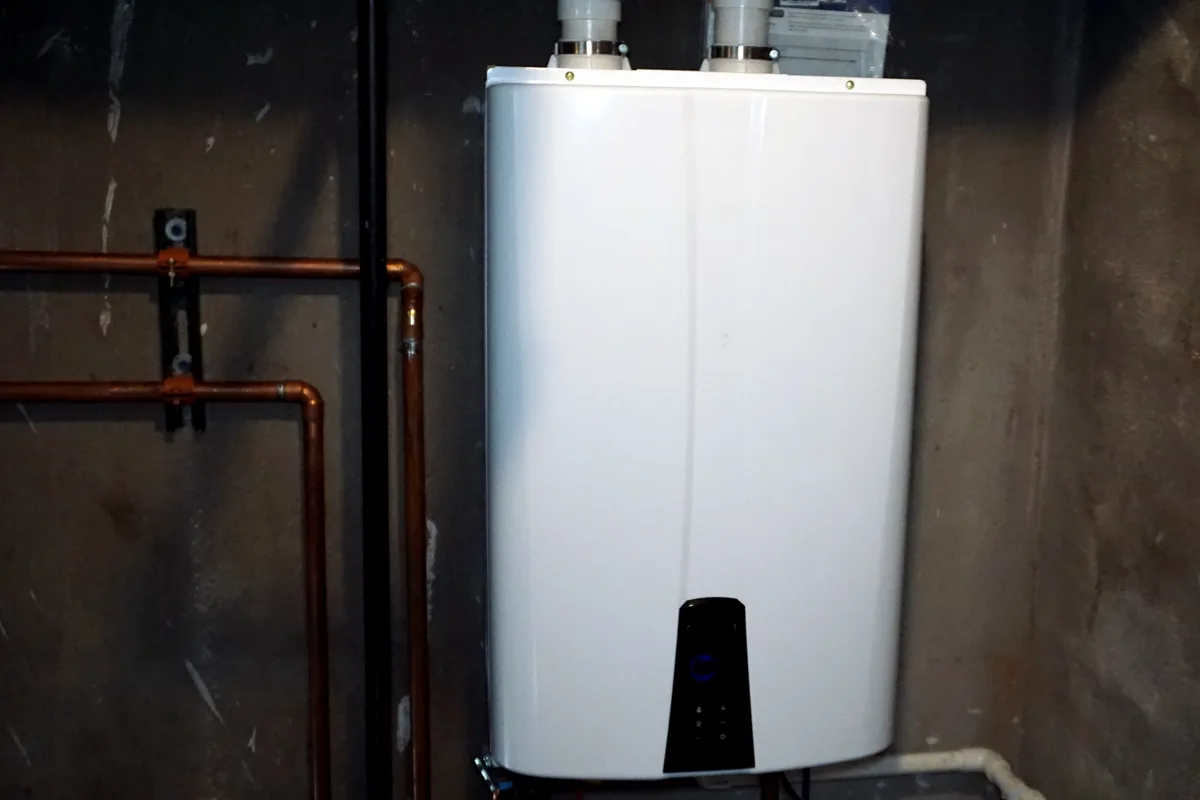
Quick answer
A tankless water heater makes noise for four main reasons: scale in the heat exchanger (rumbling or kettling), a worn combustion fan (whine or grinding), valve and sensor clicking, or vibration in the vent and water pipes. One sound is a stop sign: a loud bang or whoomp when the burner lights is delayed ignition. Shut the unit off and call a licensed gas technician.
Your tankless water heater is making noise either because a normal sound got louder or because a part is wearing out, and the kind of sound tells you which. Inside the cabinet are a fan, a burner, valves that open and close quickly, and water moving fast through narrow passages. Each has its own sound and its own way of failing.
Sounds a healthy tankless makes
- A fan hum that starts just before the burner and carries on briefly after the tap closes. That is the pre-purge and post-purge.
- One or two soft clicks at start and stop as the gas valve opens and relays switch.
- A low whoosh that rises and falls as the burner modulates with the flow.
- Faint ticking as the heat exchanger and vent warm up and cool down.
- On models with a built-in recirculation pump, a quiet hum with no tap open while the loop is kept warm.
Rumbling or kettling: scale in the heat exchanger
A rumble, crackle or kettle-like hiss while hot water runs is scale. Minerals bake onto the exchanger walls, water trapped against the hot metal flashes to steam, and the bubbles collapse noisily. On hard Halton and Hamilton water it is the first thing to rule out.
A descale flush pumps a mild acid solution through the service valves and runs $150–$300. Left alone, the scale insulates the exchanger until the unit overheats and locks out, and an exchanger cooked that way is the expensive repair. How to tell if your tankless needs descaling lists the earlier signs.
Whine, grinding or rattling: the combustion fan
A high whine that climbs with burner output, a grinding note or a rattle from inside the cabinet points to the combustion fan. Its bearings wear, and lint, dust or an insect nest drawn in through the intake throws the wheel out of balance. A fan that keeps getting louder will eventually fail to prove airflow and stop the unit on a fault, so book it while it still runs. Most tankless repairs, the fan included, fall in the $150–$800 range.
Rapid clicking: the flow sensor and modulating gas valve
Clicking that repeats while a tap runs, instead of once at start-up, is the unit trying and failing to settle. The modulating gas valve and its relays click each time the burner starts, so a flow sensor hovering around the activation point, a tap barely open or a weak flame signal makes the unit light, drop out and relight. Open the tap fully. If the clicking stops, the flow was too low; if it carries on at full flow, the flow sensor, igniter or flame rod needs attention.
A bang or 'whoomp' at start-up is delayed ignition: stop using it
A loud bang, boom or whoomp as the burner lights means gas built up in the combustion chamber before it ignited. Causes include fouled igniter electrodes, a dirty burner, incorrect gas pressure and a restricted intake or vent. Each hard light stresses the heat exchanger and the vent joints, and it can push flue gas out of the cabinet.
Do not keep testing it. Turn the unit off at its power button, close the gas shut-off on the line to the heater and call. If you smell gas, leave the house and phone Enbridge Gas from outside. Burner, igniter and gas-pressure work belongs to a TSSA-licensed gas technician.
Vent pipe vibration and water hammer
Noise that seems to come from the wall or ceiling instead of the unit is usually carried by the pipes, not made by the heater.
- Vent vibration: the fan pushes exhaust through plastic vent pipe, and a run strapped hard against a joist or missing a hanger buzzes or drones at certain firing rates. Re-hanging it with some isolation cures it.
- Water hammer: a sharp knock in the pipes when a valve snaps shut. Washing machine and dishwasher solenoids close in an instant, and the unit's own flow-control valve moves quickly too. Loose pipe straps make it louder, and a hammer arrestor at the offending appliance usually ends it.
- Condensate gurgle: condensing units drain acidic condensate through a trap. A blocked trap, neutralizer or sagging drain line gurgles and can back water up into the unit.
Check this yourself first
- Stand at the unit with a tap running and note when the sound happens: at light-off, during the run or after shutdown.
- Fully open the tap to rule out low-flow cycling.
- Write down any code on the display before it clears.
- Look at the intake and exhaust terminations outside for nests, leaves, snow or ice.
- Rest a hand on the vent pipe while it drones. If the note changes, a hanger is the problem.
- Check the date of the last descale. More than a year on hard water makes scale the leading suspect.
If the noise is coming from a storage tank instead, see why a water heater makes noise. For a tankless, ZK Mechanical services Navien, Rinnai and Bosch units, and a tankless water heater repair visit starts with a $90–$150 diagnostic that is applied to the repair. The emergency line at (647) 801-1252 is answered around the clock for a unit that banged on ignition; otherwise send us the details and include the error code if one is showing.