
Quick answer
A few small icicles at the end of a high-efficiency furnace's exhaust pipe are normal: the exhaust is cool, water-saturated vapour that freezes as it leaves. Heavy ice that narrows the opening is not, and usually means the vent slopes outward, runs too far through the cold, or ends too close to grade or under a soffit. Keep the opening fully clear and at least 30 cm above the snow.
Ice building up on your furnace exhaust pipe is a by-product of how a condensing furnace works. It takes so much heat out of the flue gas that what leaves the house is only about 40–60 °C and saturated with water, closer to a clothes dryer's exhaust than to chimney smoke. On a cold day that vapour condenses on the last few centimetres of plastic pipe and freezes. The question is how much ice, and where.
How much ice on a furnace vent is normal
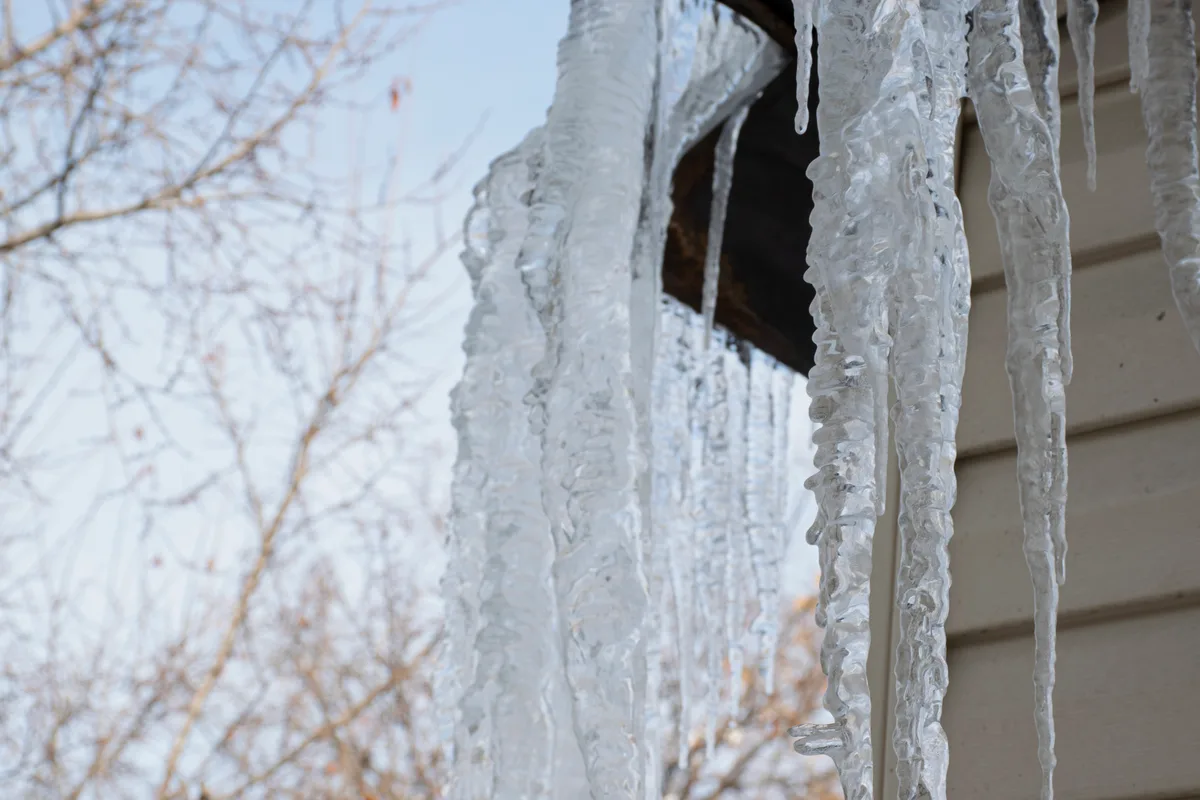
- Normal: a fringe of small icicles on the rim of the exhaust pipe, frost on the wall around it, and a patch of ice on the ground where drips land.
- Not normal: an ice ring growing inward so the opening is visibly smaller than the pipe.
- Not normal: a solid icicle from the pipe down to the ground or a snowbank, or ice bridging the exhaust and the intake pipe beside it.
- Not normal: frost or ice inside the intake pipe or on its screen, which means exhaust is being drawn back in.
- Not normal: any ice at all combined with a furnace that is locking out.
What causes heavy icing at the vent termination
Heavy ice means liquid water is reaching the cold end of the pipe, or the vapour is lingering there. A handful of installation details cause most of it.
- Vent sloped outward. The exhaust pipe should rise continuously from the furnace to the wall, typically about 2 cm per metre (a quarter inch per foot), so condensate runs back to the furnace drain. A pipe that sags or tips toward the outdoors pours water out the end, where it freezes layer on layer.
- Long uninsulated run through the cold. Pipe that crosses an unheated garage, a crawlspace or an attic, or travels a long way along an outside wall, chills the gas before it exits. Installation manuals limit exposed lengths and call for insulation on runs through unconditioned space.
- Termination too close to grade. CSA B149.1 and the manufacturer's instructions set a minimum height above grade, and the manual adds above the anticipated snow level. A vent that met that on a bare lawn can sit at drift height beside a shovelled driveway.
- Termination under a soffit, a deck or in an alcove. Still air lets the plume hang and coat everything, and under a vented soffit the moisture is pulled into the attic as well.
- Screens and fittings. Fine-mesh critter screens added after the installation ice over quickly, and so do terminations where the exhaust blows across the intake.
Housing era plays a part. Closely spaced 2000s-and-newer houses often vent into a narrow, shaded side yard where snow drifts and lingers, so a termination that cleared the grass in October can be at snow level by February. Older homes converted from a chimney to side-wall venting tend to have the opposite problem: a long pipe run to reach an outside wall.
Why ice at the vent leads to a pressure-switch lockout
The furnace proves its vent is clear before it lights. A small inducer fan pulls air through the heat exchanger and pushes it out the exhaust, and a pressure switch confirms the draft. As ice narrows the outlet or frosts the intake, the inducer cannot move enough air and the switch opens or never closes. The board retries a few times, then locks out, and how long a furnace lockout lasts explains what happens next.
That is why a furnace that fails on the coldest night and works again by noon is often a vent-icing problem. The fault code points to the pressure switch, but the switch is doing its job and replacing it changes nothing. Why a furnace pressure switch keeps failing lists the other causes. Never run the furnace with the switch bypassed, because a blocked exhaust is a carbon monoxide risk.
How to clear ice from the pipe without cracking it
- Turn the thermostat to OFF so the furnace is not trying to fire while you work.
- Find both pipes. Most high-efficiency furnaces have two, an exhaust and an intake, in white or grey plastic 2 or 3 inches across, on a side or back wall. Clear both.
- Break off hanging icicles with a gloved hand. Do not hit the pipe with a hammer, shovel or ice scraper: plastic vent pipe is brittle in the cold, and a cracked vent leaks exhaust.
- For ice stuck to the rim or inside the opening, pour warm tap water over it or use a hair dryer. No boiling water, no heat gun, no torch.
- Reach in with a gloved finger and confirm the full bore is open. Dig out the snow below and around the pipes down to bare ground.
- Sand or salt the ice patch under the vent so nobody slips. Then switch the furnace power off and on to clear the lockout and set the thermostat back to HEAT.
If the pipes exit through the roof, do not climb up in winter: that one is a service call. Vents buried by a storm, as opposed to iced from their own exhaust, are handled in what to do if a furnace vent is blocked by snow.
When vent icing needs a technician, and what the fix involves
- Call now if the furnace will not restart after both pipes are clear.
- Call now if a CO alarm sounds or you smell exhaust indoors.
- Call now if the pipe is cracked, loose at the wall or dripping at an indoor joint.
- Book a visit if the ice returns every cold snap. The cause is in the installation, and clearing it by hand each week is not a fix.
The permanent repair depends on the cause: re-hanging the pipe to restore its slope, insulating or shortening a cold run, raising the termination on a riser, or separating exhaust and intake as the manual shows. Vent work on a gas appliance is done by a TSSA-licensed technician to CSA B149.1 and the manufacturer's venting tables. There is no flat price for it, so we quote in writing after seeing the run. The diagnostic visit is $90–$150 and counts toward the repair.
ZK Mechanical repairs and re-pitches furnace venting across Burlington, Oakville, Milton and Hamilton. Call (647) 801-1252 or book a visit for furnace vent pipe repair, or for furnace repair if the furnace has already locked out.