
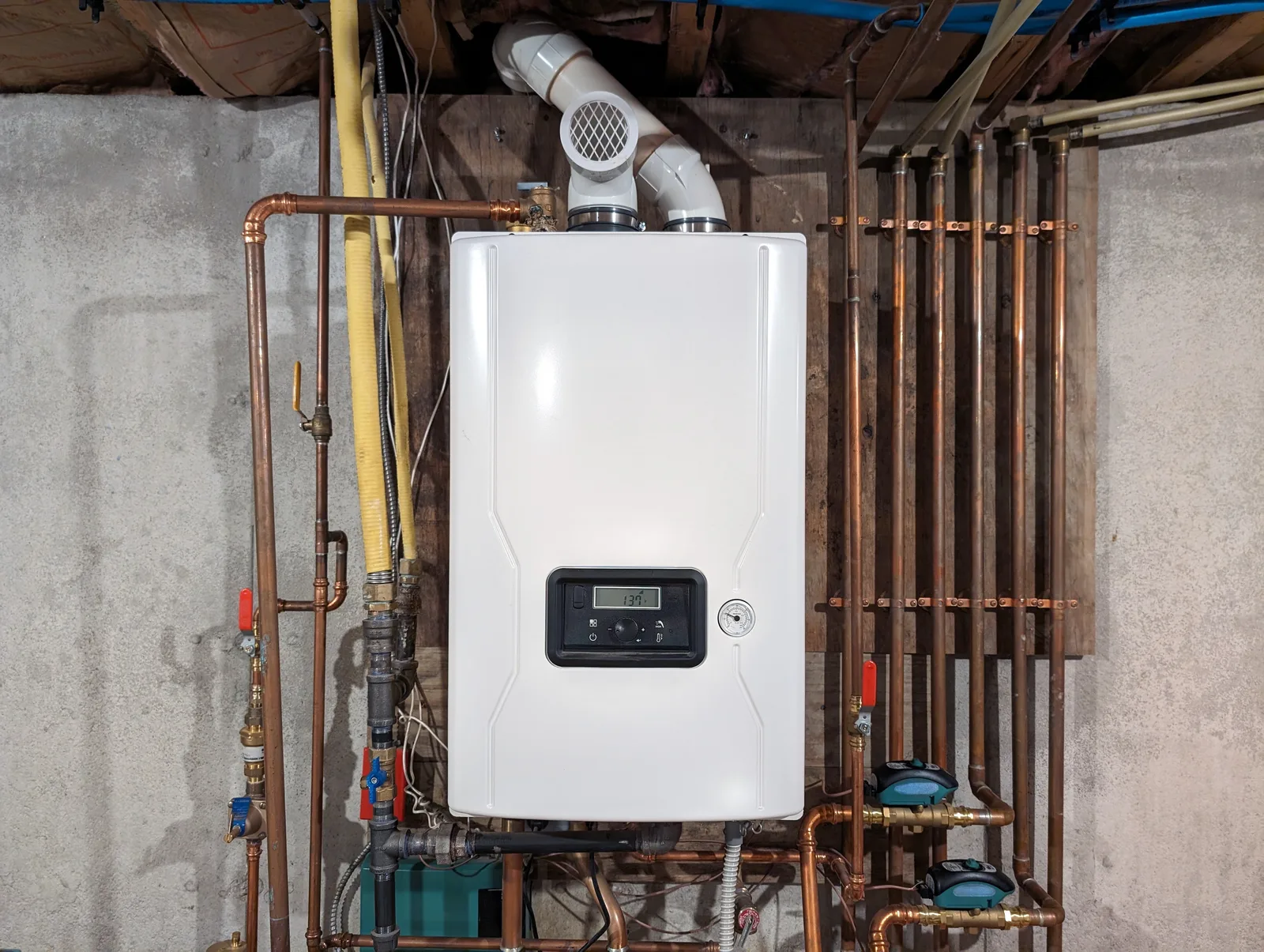
Quick answer
Rinnai error code 14 means the thermal fuse or overheat sensor has tripped: the heat exchanger ran hotter than its limit. It is not safe to keep running; Rinnai says code 14 is an indication of overheating and should be taken seriously. Turn the heater off and leave it off. There is no homeowner fix, so call a TSSA-licensed technician to find the cause before any part is replaced.
Of all the numbers a Rinnai can show, this is the one to stop for: Rinnai error code 14 means the thermal fuse or overheat sensor has tripped because the heat exchanger ran hotter than its limit. Rinnai's diagnostic guide says code 14 “is an indication of overheating and should be taken seriously”. The safety device did its job, and the open question is why it had to. Codes differ between generations, so confirm against the label inside the panel, which overrides any general description.
Why you should not reset and keep running on code 14
No, it is not safe to keep running. On SENSEI models the code comes from a bi-metal overheat switch on the heat exchanger that resets by itself once the metal cools, so the heater may appear to recover. Rinnai's warning is that the switch will keep tripping until the root cause is corrected.
Non-SENSEI models also carry thermo-fuses wrapped around the heat exchanger, and those are one-shot: once blown they must be replaced, and the heat exchanger comes out to do it. Treat a code 14 that cleared by itself the same as one still on the display. A heater that overheats repeatedly is damaging its most expensive part.
The only homeowner step: turn it off and leave it off
- Switch the heater off at the controller, then unplug it or switch off its breaker.
- Close the gas shut-off below the heater if you know which valve it is; a handle crossways to the pipe is closed.
- Do not press reset to get one more shower.
- Keep the front cover on: the fuses, the switch and their wiring are behind it, and none of them is a homeowner part.
- Write down when it tripped and what was running: a long shower, a recirculation pump, several taps at once.
What causes a Rinnai to overheat
- The wrong gas type or gas-type parameter. Rinnai's procedure starts by checking the rating plate against the gas supply and, on SENSEI models, Parameter 10 (A for natural gas, B for propane).
- The wrong gas venturi, or a fuel conversion not done to specification. A heater converted between natural gas and propane needs the matching part fitted; on SENSEI gas valves the guide identifies red as propane and blue as natural gas.
- Inadequate clearances around the heater or the vent terminals.
- Debris or scale blocking the heat exchanger. Build-up between the fins restricts airflow, scale inside the tubes restricts water, and either one leaves heat where it should not be. On older models a blackened patch where the copper meets the combustion box is the sign Rinnai tells technicians to look for.
- Damaged overheat-sensor wiring: a loose connector or a broken wire in the safety circuit reads as a trip.
What the technician has to confirm before replacing anything
Replacing the fuse or switch without finding the cause sets up the next trip. The visit starts with gas type and pressure: the rating plate, the gas-type setting, and the manifold pressures at low and high fire measured with a manometer. The safety circuit is then checked with a meter to see whether the switch is open or a fuse has blown.
Next comes the heat exchanger. The front, sides and back are inspected for cracks, separation and discolouration, and Rinnai's instruction is to replace it if any are found. If it is sound, the technician flushes it to remove scale and cleans debris from the fins, then checks clearances and vent length.
Repair or replace after a code 14?
The inspection decides it. A wrong setting, a wiring fault, or a scaled heat exchanger that flushes clean is a repair.
- Diagnostic visit: $90–$150, counted toward the repair.
- Descale flush on its own: $150–$300.
- Most tankless repairs: $150–$800.
- New tankless water heater, if the heat exchanger is cracked or discoloured and replacing it does not make sense: $3,500–$6,500 installed.
A heat exchanger replacement has no standard price; it is quoted in writing with the part and the labour shown, and that quote is what you weigh against a new unit. Ask whether the manufacturer's heat exchanger warranty still applies before you decide.
ZK Mechanical is a TSSA-licensed contractor in Burlington that services Rinnai, and on a code 14 call the first job is the cause, not the part. Call (647) 801-1252, send the details, or read how a tankless water heater repair visit runs. The neighbouring fault, code 16, is a high outlet water temperature shutdown; scale warnings are covered under code LC; the rest are in the Rinnai error code guide.