
In short
R-22, often called Freon, is the refrigerant inside most central air conditioners installed in Ontario before about 2010. It damages the ozone layer and has been phased out, so recovered and reclaimed R-22 is what remains for service. Rule of thumb: fix small electrical faults on an R-22 system, but treat a refrigerant leak or a failed compressor as the time to replace.
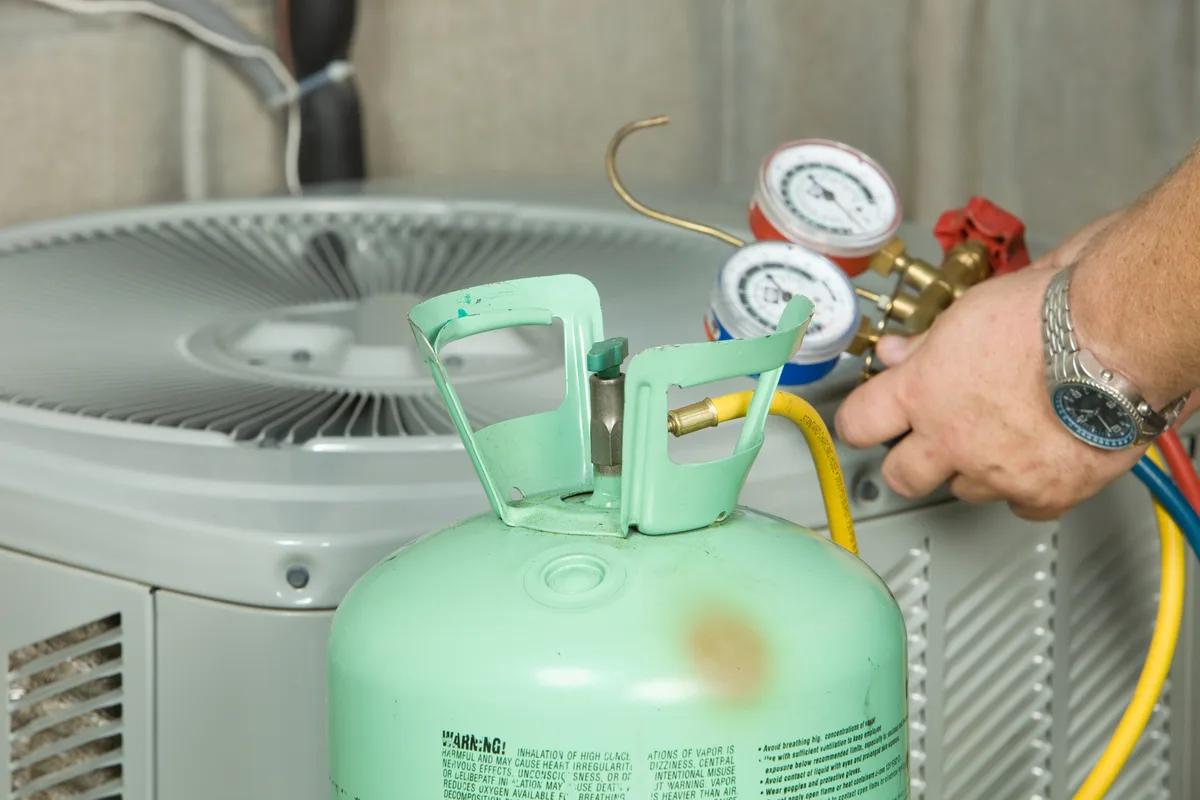
R-22 is the refrigerant your air conditioner almost certainly runs on if the outdoor unit is original to a house built before about 2010. Chemists call it HCFC-22 or chlorodifluoromethane; most people call it Freon, which is a trade name. It cooled Canadian houses for decades, but every kilogram that leaks thins the ozone layer, so Canada and the other Montreal Protocol countries agreed to phase it out.
How to tell if your air conditioner uses R-22
Read the nameplate on the outdoor unit. The rating label on the back or side of the condenser names the refrigerant as R-22 or HCFC-22 beside the factory charge weight. A label that says R-410A, R-32 or R-454B means a newer system.
Across Burlington, Oakville, Mississauga and the rest of the GTA, an air conditioner original to a pre-2010 house is likely R-22. Home inspectors flag it on pre-sale and pre-purchase reports, because the buyer is inheriting a unit that is past its expected life and cannot be topped up cheaply.
Why an R-22 leak means replacement, not repair
The decision rule is short: a refrigerant leak or a failed compressor on an R-22 system is the point to replace it. Under the phase-out, service supply comes from refrigerant recovered out of scrapped units and reclaimed, and that stock shrinks every year. Any R-22 system still running is also around 16 years old or more.
- R-22 and R-410A equipment are not interchangeable: R-410A runs at much higher pressure and uses a different compressor oil, so a new outdoor unit cannot be paired with an old R-22 coil
- Substitute blends sold as 'drop-in' replacements give up cooling capacity, are not approved by the maker of the original equipment and cannot be mixed with the R-22 still in the system
- The indoor evaporator coil has to be changed along with the outdoor unit, and the copper line set is usually replaced too, or flushed and pressure-tested where it runs through finished walls
- Topping up without fixing the leak is not a repair: refrigerant must be recovered, never vented, and only a technician holding an ODP card may handle it in Ontario
What is still worth repairing on an R-22 system
Faults outside the sealed refrigerant circuit are still worth fixing. A capacitor or contactor is a $150–$350 repair on a unit of any age, and the diagnostic visit is $90–$150, folded into the repair if you proceed. If the system holds its charge and cools the house, no rule forces you to remove it.
The math changes once the sealed system has to be opened. Most AC repairs run $150–$800, a replacement central air conditioner installs for $4,500–$7,000, and money spent on reclaimed refrigerant buys nothing you keep. Our answer on whether a 10-year-old AC is worth repairing works through the same trade-off for younger units.
What replaces an R-22 air conditioner in 2026
A replacement is a complete matched system: outdoor unit, indoor coil and, in most houses, a new line set. New equipment now ships with R-454B or R-32, the refrigerants explained in our A2L refrigerant guide, and it must meet the 13.4 SEER2 federal minimum for split systems. The old R-22 is recovered into a cylinder before the unit leaves your yard.
ZK Mechanical quotes air conditioner installation in writing after seeing the house, and we will say so plainly if the existing unit only needs a small part. For other terms on your quote, see the HVAC glossary, or book a visit to have the nameplate read and the system checked.
Questions people ask about R-22
Is it illegal to keep using an R-22 air conditioner in Ontario?
No. Owning and running an R-22 system is legal, and there is no deadline that forces you to remove it. The restrictions apply to supply and handling: the refrigerant has been phased out, it must be recovered instead of vented, and only a technician with an ODP card may work on the sealed system. The practical limit is the cost and scarcity of reclaimed refrigerant.
Can an R-22 system be topped up with R-410A or another refrigerant?
No. R-410A operates at far higher pressure and needs a different oil, so it cannot go into R-22 equipment at all. Substitute blends exist, but they cannot be added on top of the remaining R-22: the old charge has to be recovered first, and the system then runs with less capacity and without the manufacturer's approval. On a unit this old, that money is better put toward replacement.
Does an R-22 air conditioner affect a home sale?
It gives the buyer a negotiating point. A home inspector will note the refrigerant type and the unit's age from the nameplate, and most buyers read that as an air conditioner they will be replacing soon. A seller can price that in, offer a credit or replace the system before listing. A written quote for a new system gives both sides a real figure to work from.