
Quick answer
A furnace that can't keep up at -25 °C is usually working as designed. Ontario furnaces are sized to a design temperature of roughly -17 to -20 °C around Burlington, Hamilton and Toronto, so below that it runs non-stop and the house can sag 1 to 2 °C. A gap that keeps growing, or burners that cycle off while the thermostat still calls, means a fault.
The plain reason your furnace can't keep up when it is -25 °C outside is that nobody sized it for -25 °C. A furnace is matched to the heat the house loses on a typical coldest night, not the rarest one, so a few nights each winter ask for more than it has. On those nights a healthy furnace runs without stopping and the house settles a degree or two under the setpoint. The job is to tell that normal sag from a furnace that has lost part of its output.
Furnaces are sized to about -17 to -20 °C, not -25 °C
Heating equipment in Ontario is sized from a heat loss calculation that uses the outdoor design temperature the Ontario Building Code lists for each municipality. Across Burlington, Hamilton and Toronto those figures sit at roughly -17 to -20 °C, a temperature the area stays above for all but a small share of January hours. The CSA F280 heat loss calculation works out how much heat the house loses at that outdoor temperature, and the furnace is chosen to match.
At -25 °C the house loses more heat than the calculation assumed, so the furnace's full output holds the indoor temperature only part of the way. Non-stop running and a 1 to 2 °C sag in the coldest hours before dawn is expected, and the house recovers once the sun is up. A bigger furnace is not the cure: an oversized unit short-cycles through the rest of the winter. Our furnace sizing guide explains the trade-off.
How to tell a normal sag from a furnace fault
A furnace that is merely at capacity runs continuously with hot air at every register. A furnace with a fault shows one of these instead:
- Burners shut off while the blower keeps running, then relight a few minutes later. That is limit cycling: the high-limit switch opens because the furnace is overheating, almost always behind a dirty filter or a blocked return, and every minute the burners sit out is heat the house does not get.
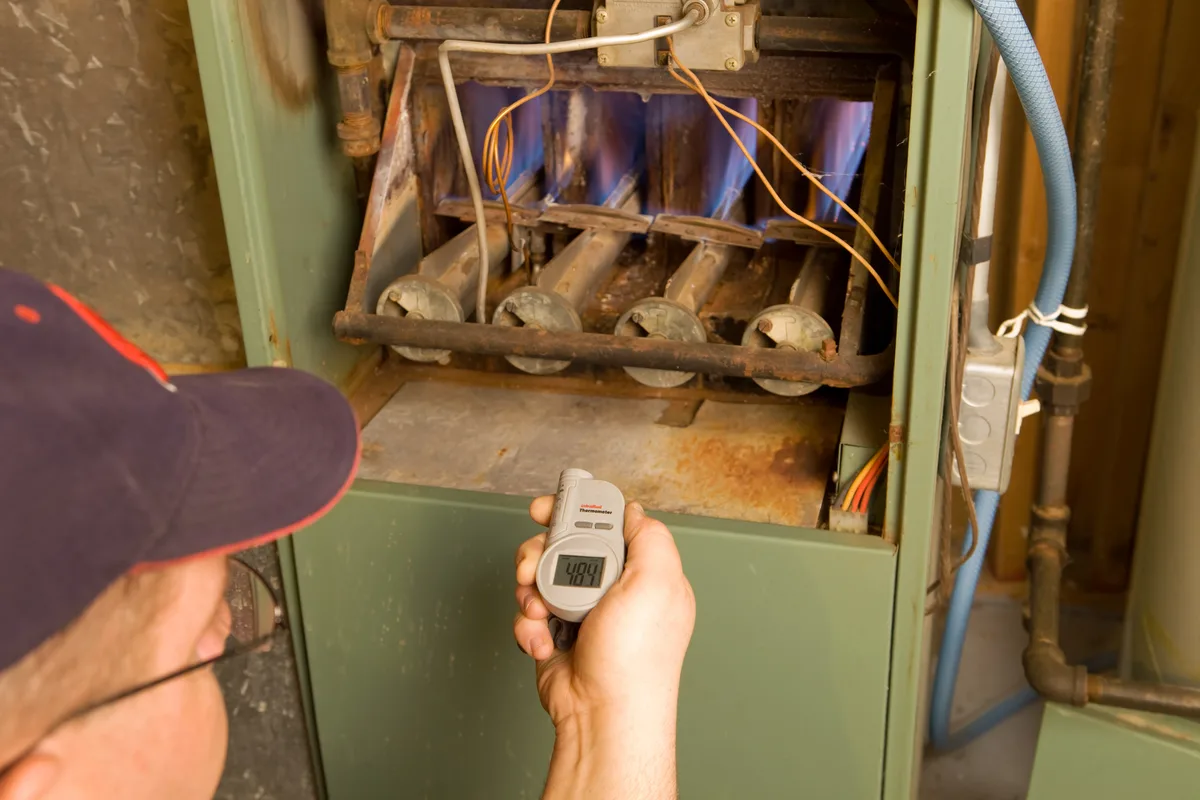
- Supply air that feels lukewarm. Technicians measure temperature rise, the difference between return air and supply air, and compare it with the range on the rating plate (a common one is 35 to 65 °F, about 19 to 36 °C). Rise above the range means too little airflow; rise below it points to low gas input or leaking ducts.
- Frost closing in the intake pipe outside. The plastic intake of a high-efficiency furnace can frost over in deep cold, starving the burners until the pressure switch stops them.
- One or two rooms going cold while the basement gets warmer. A supply duct that has slipped apart at a joint dumps its heat into the basement or crawlspace, and the loss only shows when there is no spare capacity.
- A gap that keeps growing: 2 °C below setpoint at midnight, 4 °C by morning, still falling at noon.
Cold-snap rules that keep a furnace at full output
- Do not set back at night. A furnace at capacity has nothing left to recover with, so a 3 °C setback at bedtime can take until the next afternoon to win back. Hold one temperature until the cold breaks.
- Keep every register and return grille open. Closing off rooms raises duct pressure and pushes the furnace toward its limit switch.
- Put in a clean filter before the cold arrives, and look at it again after a week of non-stop running.
- Keep the intake and exhaust clear of snow, frost and drifts. Check them after wind as well as after snowfall; what to do if the furnace vent is blocked by snow has the safe way to clear them.
- Close blinds at night, open them on sunny south windows by day, and run kitchen and bathroom exhaust fans only as long as needed. Each fan throws heated air outside.
- Shut the damper on a wood fireplace that is not in use.
Which houses fall behind first
The houses that sag most are the ones losing the most heat for each BTU of furnace. In this area that means 1950s and 60s bungalows with thin attic insulation, pre-war brick homes with uninsulated walls, and rooms over garages in 1970s to 90s subdivisions. Exposure matters too: a house on the Escarpment brow or an open rural lot in Caledon or Flamborough loses more to wind than the same house on a sheltered street. A new furnace sized tightly to a careful heat loss calculation will also show the sag sooner than the oversized unit it replaced, and that is normal.
When a growing gap means a service call
Call for service when the indoor temperature keeps dropping instead of levelling off, when the burners cycle off during a continuous call for heat, or when the supply air has gone lukewarm. Call the same day if the house is below about 16 °C and still falling, since water pipes on outside walls are next. A steady 1 to 2 °C sag that recovers by afternoon can wait for the cold to pass, and is worth raising at the next tune-up so the temperature rise and gas pressure get measured.
A diagnostic visit is $90–$150 and is folded into the repair if you go ahead. Most furnace repairs land at $150–$800, and a limit-cycling furnace is often fixed by restoring airflow. ZK Mechanical answers the phone 24/7 at (647) 801-1252 with no after-hours surcharge: book furnace repair or send us a message. If the house is cold all winter and not only in a cold snap, start with why the house is cold with the furnace on.