
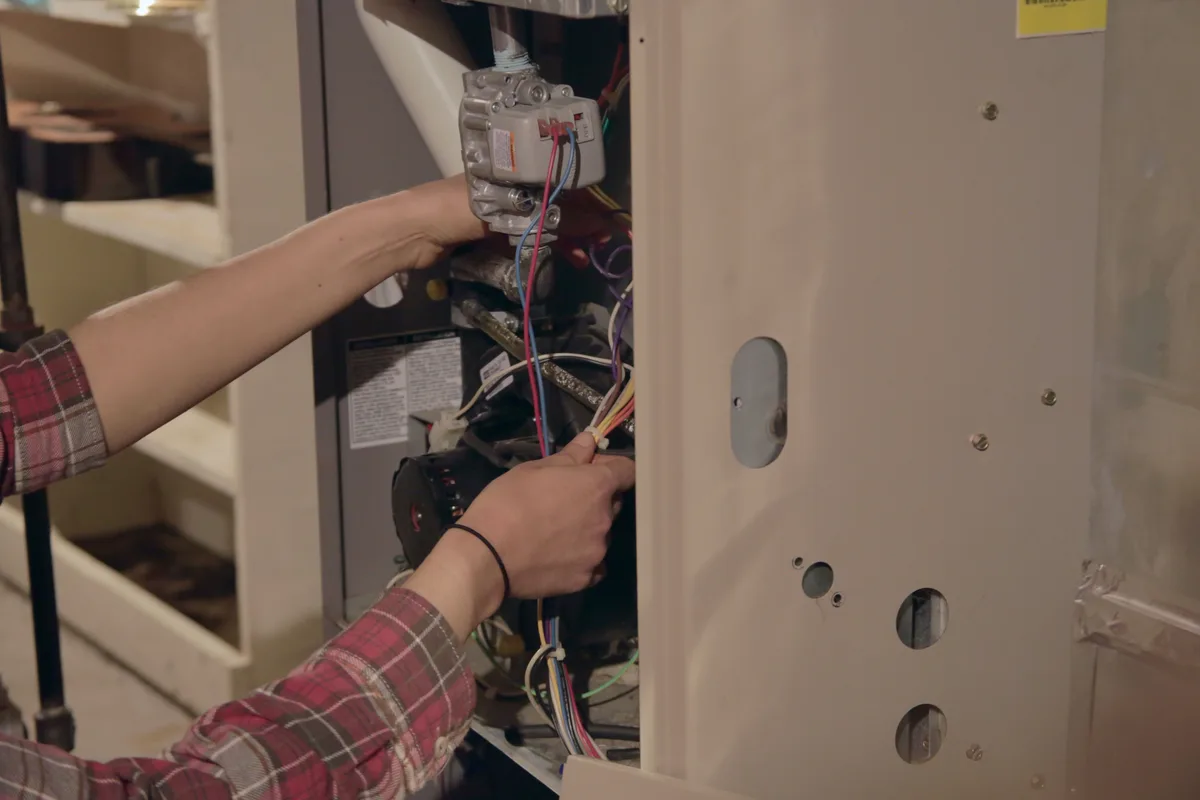
Quick answer
A furnace flame sensor costs $150–$300 in the GTA, cleaned or replaced, and that figure normally includes the service call. The rod itself is a cheap piece of stainless steel. What you are paying for is a licensed technician's visit, the cleaning done without scoring the metal, and a microamp test afterwards proving the signal is strong enough to hold the gas valve open.
Flame sensor work is the least expensive of the common furnace repairs, and it resolves more no-heat calls than anything else: $150–$300 covers cleaning or outright replacement on nearly every residential furnace we open. The part is a single steel rod on a ceramic base, worth a few dollars wholesale. The price is time, a truck, a licence and a meter.
What the sensor does, and why it shuts the furnace down
The rod sits in the flame at one end of the burner assembly and works by flame rectification: the flame conducts a tiny alternating current in one direction only, and the board reads the resulting direct current in microamps. A clean rod in a good flame typically produces a few microamps, and most boards want at least about one before they will hold the gas valve open. A film of silica or oxide on the steel drops the signal under that threshold.
The symptom is unmistakable once you know it. The burners light, run for a handful of seconds, and the gas cuts. The furnace repeats that two or three times, then stops trying. Nothing sounds broken, which is exactly why people keep resetting it.
What the $150–$300 flame sensor price includes
- The diagnostic visit — $90–$150 across the GTA, and at ZK Mechanical it comes off the repair when you proceed.
- Pulling, cleaning and refitting the rod using a fine abrasive pad rather than coarse sandpaper, which scores the steel and makes it foul again sooner.
- The part itself when the rod is pitted, thinned or cracked at the ceramic base — replacement lands in the same $150–$300 band.
- A microamp reading taken before and after, so there is evidence the fix worked instead of a hopeful guess.
- A look at why it fouled, which is the piece that decides whether you are back in three months.
Can you clean it yourself?
Plenty of homeowners do, and this is the one furnace part where that is a defensible choice: power off at the switch, one screw, pull the rod, scuff it, refit it. What a homeowner cannot do is the part that matters — measure the signal, verify the ground path, and inspect the burners for the reason deposits are forming. In Ontario, anything beyond that on the gas side needs a TSSA-licensed technician.
Our rule of thumb is simple. Cleaning it once is fine. Cleaning it twice inside one heating season means you are treating a symptom, and something else in the house is putting that coating on the rod.
Why some houses foul sensors faster
- Weak grounding. Flame rectification needs a solid ground back through the burner assembly to the board, and a loose burner screw or a corroded ground wire imitates a dirty sensor precisely.
- Renovation dust. Drywall sanding pulls silica straight into the return and it bakes onto the rod as a white glaze — a familiar story in the 1970s and 80s basements being finished across Millcroft and Glen Abbey.
- Depressurization. A powerful range hood, a bank of bathroom fans or a wood fireplace in a tight house can pull the flame off pattern so it barely reaches the rod.
- Burner deposits. Rust flakes off an ageing heat exchanger, or lint drawn in from a dryer beside the furnace, change the shape of the flame.
- Chlorine and softener salt. Burner air drawn from a laundry or pool room leaves aggressive deposits on both the rod and the burner ports.
When the sensor is not the answer
If the signal reads strong and the furnace still drops out, the fault is somewhere else: an igniter lighting the burners late, a gas valve drifting off pressure, or a control board that has lost the ability to read the sensing circuit at all. Those move the number up — an igniter runs $200–$450 and a board $500–$1,200 — which is precisely why the meter should come out before any parts do.
Flame sensor cleaning is a standard line item in a proper tune-up, so if the furnace is due anyway, a $120–$250 tune-up covers it along with the burner inspection that explains the fouling. See what a furnace tune-up includes, look at maintenance plans if you would rather it were scheduled for you, or call ZK Mechanical at (647) 801-1252 for furnace repair in Burlington, Oakville and Hamilton — book here.