
Quick answer
Yes. You can replace a rental water heater with your own tankless as long as the rental account is closed properly: get a return authorisation from Reliance or Enercare first, have a licensed gas technician disconnect the tank, install the tankless, then return the tank and keep the receipt. A typical conversion runs $4,200–$5,000 installed, plus whatever the rental agreement charges to end the contract.
Yes, you can replace a rental water heater with your own tankless, and the job is two projects running side by side: closing a rental account and converting the house from a storage tank to an on-demand unit. The paperwork has to start first. Reliance and Enercare each authorise the return of their tank, and a tank that leaves the basement without that authorisation is where surprise charges come from. The install itself is one working day in most houses.
The order that keeps the rental company from billing you
- Call the number on the tank's sticker with your account number and the tank's serial number. Ask for the buyout figure, the return or removal charges and the return authorisation, all in writing. Reliance calls its number a Pending Return Number.
- Get a written quote for the tankless that names the model, the gas line work, the venting route and the electrical outlet, so both sets of numbers sit side by side.
- Book the install. A TSSA-licensed G2 technician shuts off and disconnects the rental tank, deals with its gas and vent connections, and drains it.
- The tankless is hung, piped, vented, pressure tested and commissioned, usually the same day.
- The old tank is tagged with the authorisation number and goes back by pickup or to the company's depot, whichever your agreement specifies. Who moves it is settled before the job is booked and written on the quote.
- Watch the next bill or two. The account is closed when the final statement shows zero, not when the tank leaves the driveway.
If the rental tank is only a few years old, the buyout or early-termination figure may be large enough to change the plan. How a rental buyout is calculated explains what drives that number. On a tank past ten years the figure is usually small, and the conversion is the natural moment to stop renting.
What a tank-to-tankless conversion adds to the house
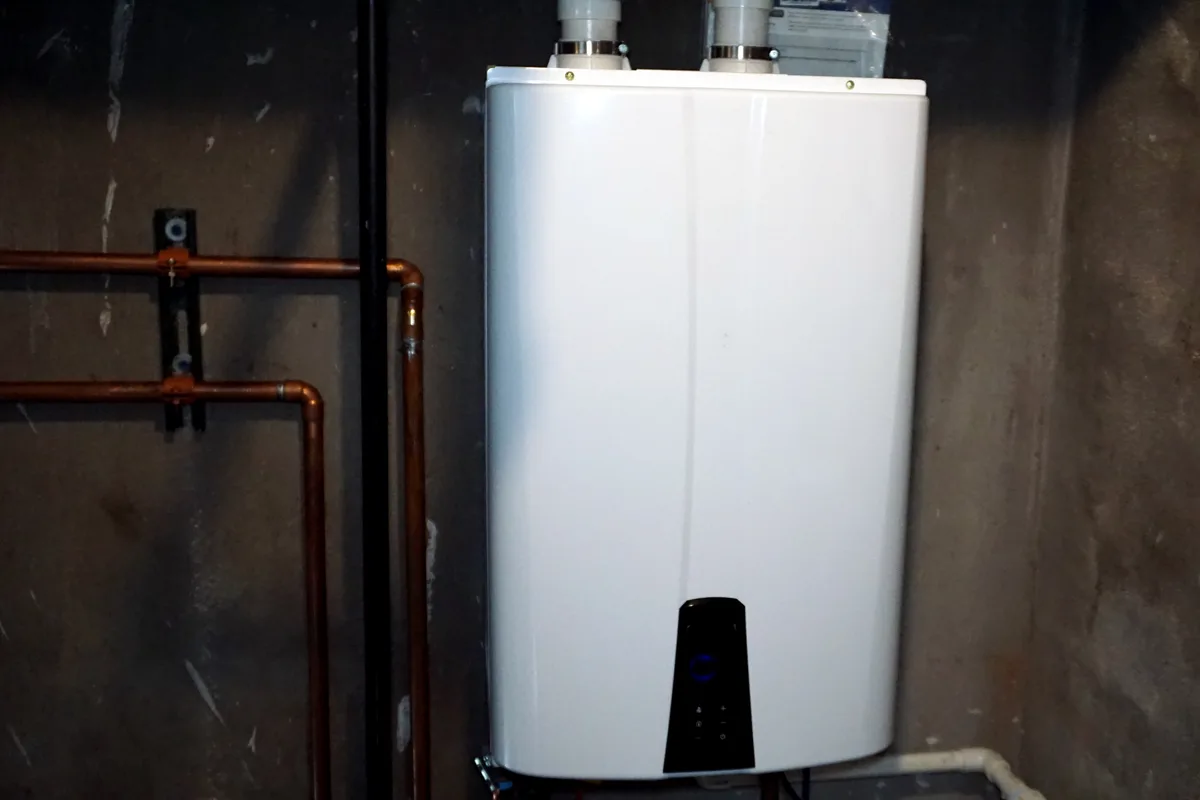
A tankless is not a drop-in replacement for a rental tank, because it burns several times as much gas while it is running. A typical gas tank is rated around 40,000 BTU an hour; a whole-house tankless is commonly rated at 199,000. That difference is behind most of the extra work.
- A larger gas line: often 3/4 inch back toward the meter for a 199,000 BTU unit, sized by the length of the run and the other appliances sharing it. Whether a tankless needs a bigger gas line goes through the sizing.
- New sidewall venting: a condensing tankless vents through the wall in plastic pipe approved for that unit, not into the old tank's metal vent or the chimney.
- A condensate drain: condensing units produce acidic water as they run, and it has to reach a floor drain, a laundry standpipe or a small pump.
- Isolation valves: a pair of service valves at the unit so the heat exchanger can be descaled, which matters on the hard water in Halton and Hamilton.
- A 120 V outlet within reach of the cord. The fan, controls and igniter need power that a standing-pilot tank never did.
The old vent needs attention too. Where the rental tank shared a chimney with a furnace, the technician checks what is still connected to that chimney once the tank is gone and seals the unused opening.
What it costs to switch from a rental tank to an owned tankless
Two costs have to be lined up: what the rental agreement charges to end the contract, and what the conversion costs. Only the rental company can give you the first number, and we will not guess at it. The published bands for the second are:
- Tank-to-tankless conversion in most houses: $4,200–$5,000 installed for a mid-tier 199,000 BTU gas unit.
- Full range across unit sizes and venting routes: $3,500–$6,500 installed.
- Gas line upsizing where the existing run was sized for the old tank: +$400–$1,200.
- Annual descale flush once you own the unit: $150–$300.
No current Ontario program pays a rebate for a gas tankless water heater, so do not build one into the budget; the tankless rebate page tracks what is open. For comparison, the rental you are leaving typically runs $25–$45 a month for as long as the tank stays in the house.
When swapping a rental for a tankless is not the right move
A tankless suits a household that runs out of hot water or plans to stay put for years. If you are selling within two or three years, an owned tank at $1,200–$2,500 installed ends the rental for less money. If the gas meter sits at the far end of a finished basement, the gas run can be the largest part of the job, and a site visit is the only way to price it. A power-vented rental tank already has an outlet beside it, which takes one item off the list.
ZK Mechanical installs and services Navien, Rinnai and Bosch units across Burlington, Oakville, Hamilton and the west GTA, with the price written down before any work starts. See tankless water heater installation for what the conversion day involves, browse more water heater answers, or send us the rental details and a photo of the tank and we will price the conversion.